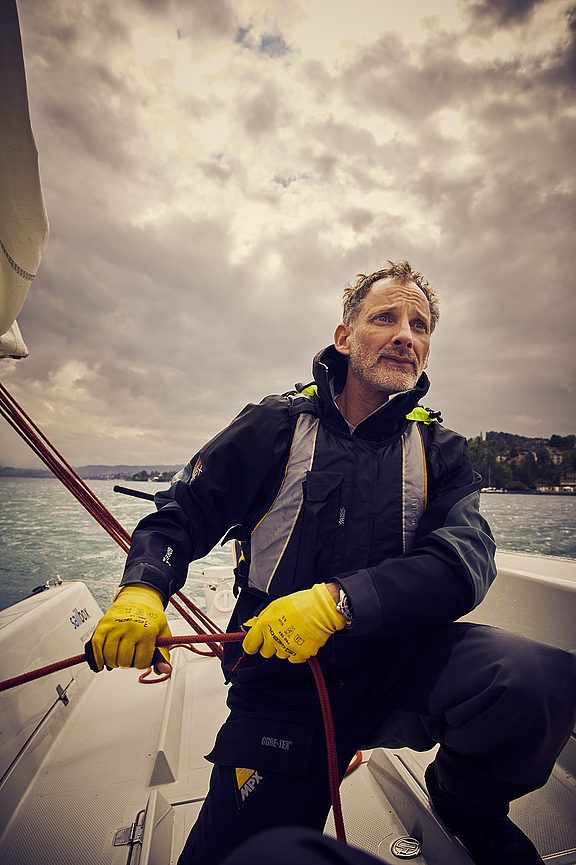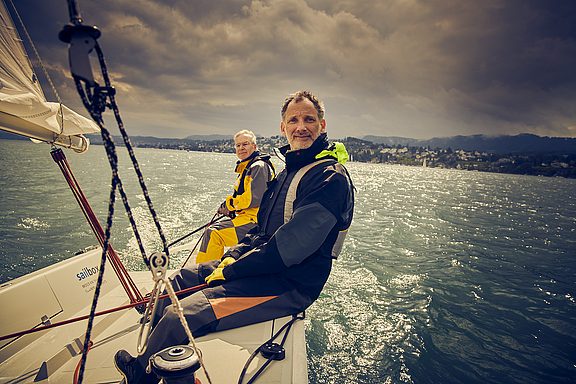
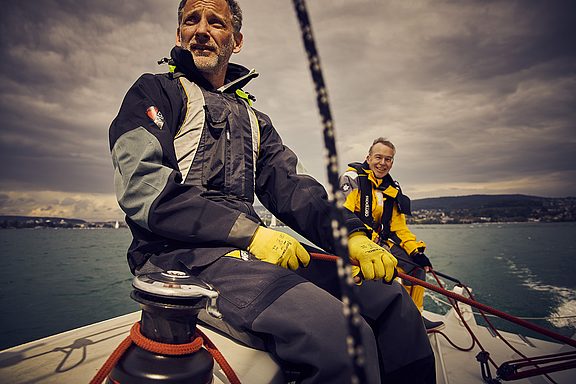
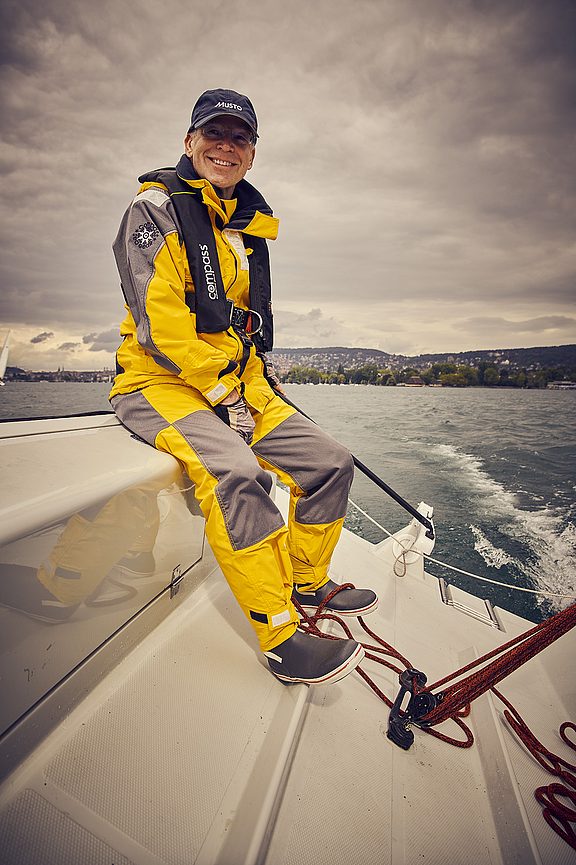
We met Winfried Seidinger and Christian Schneider from Swiss company Lemon Consult AG for a sailing trip on Lake Zurich to discuss current sustainability issues.
Winfried Seidinger, founder and partner of Lemon Consult AG
A trained electrical engineer, graduate electrical engineer (FH) and energy engineer (NDS FH), Winfried Seidinger founded Lemon Consult AG in Zurich in 2000. He develops energy and technology concepts for competition designs as well as for new construction and renovation projects. He also supports the development of entire areas with regard to energy issues. Many of his projects have shaped the cityscape of Frankfurt.
Christian Schneider, Partner at Lemon Consult AG
Joined Lemon Consult AG in 2008 and has been a partner and member of the management board since 2019. As a graduate in environmental science, he advises builders and architects on sustainability and energy efficiency, prepares energy and feasibility studies on energy efficiency measures and renewable energy generation. He also investigates the feasibility of sustainability and energy labels and works on research projects.
In keeping with our sailing trip, according to IZ, the real estate industry in Germany fears that 50 to 75 percent of existing properties in Germany could become so-called "stranded assets," properties that can no longer be placed on the market. There is a little bit of fear about how this will develop. How are things in Switzerland? Have your phones been ringing off the hook since the introduction of the EU taxonomy?
Christian Schneider (CS): It has certainly had an impact on our order situation, but I wouldn't say that the phones are ringing off the hook. I think the panic is limited. It doesn't directly affect Switzerland because we are not in the EU. It does affect internationally active companies that are embedded in the European system and active in the financial market. So things are still relatively calm here, but you can already see that larger investors are feeling a certain pressure to steer their investments toward sustainability. What I can't imagine, however, is that we will simply write off 50 percent of our real estate. I believe that the loss in value is lowest if you tackle it and renovate. And of course, this requires all parties involved, all stakeholders, including cities, municipalities, and local authorities.
Winfried Seidinger (WS): Investors and portfolio holders will look very closely at which properties they can use to achieve the EU taxonomy targets at a reasonable cost. They will probably sell off the rest. I can well imagine that this will separate the wheat from the chaff. However, I do see additional pressure on the real estate industry, which will lead to increased demand for us. Projects that may be on the brink of collapse and at risk of being abandoned will get a new boost. I don't think we'll be out of work anytime soon.
Gregor Gutscher (GG): We are currently noticing a change in mindset in many projects, and solutions that Winfried and I conceived 20 years ago and have already partially implemented are now becoming the norm. Back then, our ideas often failed due to economic considerations. Now we are dusting off all those old ideas. We are currently doing this with almost every project. We are taking on X percent more TGA costs to achieve these goals, especially in renovation projects.
Has this topic resonated with your customers, or do you sometimes still have to play the missionary?
WS: There are both. There are builders and architects who see this as an opportunity to realize something sustainable and creative (e.g., reuse, cradle to cradle). However, there are also others who only see the additional expense and a restriction on their creative freedom. The path to net-zero CO₂ by 2050 is clearly defined. However, the reality of implementation is often not quite so simple. It requires a holistic approach and many small individual measures for optimization, which together result in added value.
With the introduction of the EU taxonomy, "hard" criteria must now be met. We must face these new circumstances and work together to find new solutions. It's an exciting challenge that is worth investing in with gusto.
GG: You also have to be brave enough to take new, perhaps unconventional paths, such as your idea of heating desks and chairs in offices instead of the entire building!
WS: There are many ways—some of them unconventional—that can lead to the goal. If the building envelope is constantly improving, then you have to ask yourself, for example, whether it is
still worth investing a lot of money in building services engineering, or whether the money might be better or more sustainably invested elsewhere. We then look for the best possible simple solutions. Our integrated knowledge of building physics, sustainability, and building services, as well as the development and application of a wide range of simulation tools, helps us in this endeavor.
Holger Meyer (HM): We all know what is right in principle. We have a lot of new technical possibilities, but the key difference is that there have been legal requirements since 2022. Owners and developers now have to deal with this. There is no longer any alternative. And that naturally leads to a whole new and different discussion across the board.
CS: In recent years, there has also been a generational change. People who have been dealing with the issue for a long time are coming to the fore. That makes the discussion easier. We are discussing practical solutions rather than fundamental issues. To achieve the goals, we need everyone involved, from landscape planners and architects to structural engineers and, of course, the building owners who are responsible for the projects. These constellations are more likely today than they were two years ago.
GG: That's right, we notice this in other areas of our office. There are new young colleagues with perhaps two or three years of professional experience who come up with different ideas. They like to shake me out of my usual rut when I pull out my standard specifications: 3.50 m floor height, 8.10 x 5.40 m column grid, 30 cm ceiling, 400 sq m usable area... Then they ask questions like: What about wood hybrid? Then I think: Okay, after giving it a moment's thought, you can also do it differently, which leads to different parameters in the details. But for me, that's exactly the point: even if you've been in the business for a long time, you're still able to question things as a whole. And it's really good that things are suddenly possible because the mindset on the client side has changed significantly.
In addition to the mindset, digitalization helps us to identify and leverage potential. BIM and CREEM are already very widespread in large-scale projects involving new construction. How do you use these digital tools in your work?
WS: In our work, we focus on reducing the resource requirements of buildings and then covering the remaining requirements with renewable energies and materials, etc., wherever possible. Digital models—today we talk about digital twins—and the use of simulation tools help us to predict future energy requirements and thus CO₂ emissions. In the future, we will be able to feed the digital twin with effective usage data and effective climatic conditions and make more refined forecasts. However, digital models not only enable an integrated approach at the room or building level, but also make it possible to consider neighborhoods and districts. Today, we can simulate issues such as heat islands, microclimates, good ventilation, and downdrafts caused by high-rise buildings, and provide sustainable support for optimizing neighborhood and urban planning.
For me, these are extremely exciting topics: advancing sustainability in urban development. So it's not just about planning individual properties sustainably, but asking on a larger scale: What is truly sustainable? And in the countryside, you come up with completely different solutions than in the city. Seeing these things is what really makes it special for me. We are seeing a constant urge to move to cities, whose space requirements are increasing, and we really need to move towards higher density and space efficiency there. Conversely, we have to ask ourselves what is actually needed in rural areas. In the future, it may even be necessary to dismantle buildings there or make these areas available for use as material storage. That's another difficult discussion, because it's about home. But if you think about sufficiency in the right way, you have to take such considerations into account and not just focus on individual buildings.


Urban mining in rural areas?
CS: Urban mining is already a hot topic. The problem of CO₂ emissions from operations can be technically controlled. However, we still have major problems when it comes to bound CO₂—which is bound in all materials used in the construction of a building. This starts with steel, continues with concrete, and extends to glass and other components that have bound much more CO₂ than is produced during operation. And that's where urban mining, the recycling of existing and used materials, comes in as a way to reduce bound CO₂ through reuse. It is precisely this type of reuse that is needed to reduce greenhouse gas emissions, but also to save resources overall. Metals such as copper or aluminum, for example, are in limited supply or can only be produced at high energy costs. In the future, we will have to rely on resources that have already been used, and this will also be worthwhile in the future.
For architects, however, there is another crucial factor: they must design future buildings in such a way that components can be easily dismantled and reused, which also makes such buildings more cost-efficient. In the future, it will be possible to engage in urban mining at much lower cost with such properties and thus resell the components at a higher profit. And the goal must be to bring them to market in such a way that they can be reused immediately. Don't we
all need to think and act more sufficiently overall?
WS: For me, sufficiency has a broader dimension. Sufficient thinking and acting must be established in many areas, and in the future we will have to ask ourselves questions that may not always be easy to answer. I am thinking, for example, of my parents' house. My father now lives there alone in 180 square meters of space. In my opinion, this kind of inefficient use of space should be questioned and constructive new solutions sought. Then we would quickly have living space for families again. We are currently having such discussions with housing cooperatives in Zurich, and this is already moving in the direction of sufficient use of living space: families in the cooperative are entitled to an apartment with four and a half or five and a half rooms. But once the children have left home, you are allocated a three-and-a-half-room apartment in the same cooperative.
GG: In 2012, I visited the exhibition "40 Years of Olympic City" organized by the Munich City Planning Office. The average square footage of apartments per inhabitant in 1972 and 2012 was marked on the floor with gaffer tape. At that time, the factor was two. Now it is certainly even a factor of three.
CS: But the topic of sufficiency has many more facets than just space efficiency. This winter, we can practice what it means to act sufficiently. For example, by turning down the room temperature in buildings to 19 or 20 degrees. And then we come to the next discussion: Is that even legally permissible? And that's where I see the next problem: We have constantly raised the bar in terms of standards and laws. Now it may be time to take a step back in some areas and allow a little more leeway again.
GG: Exactly! When in doubt, you just have to rethink existing rules!
Will we manage the turnaround?
WS: We are engineers—we always manage it. Engineers are purposeful optimists. Many solutions lead to the goal, even if there are detours that have to be taken. But I am an optimist and I say: We can do it.
CS: I am a scientist and an engineer. We have to hurry up and we still have a huge task ahead of us. We can do it. Globally, the task is even greater than in Europe. And it won't work unless we tighten our belts, i.e., we all act more sustainably.
HM: It won't work without leaving our personal comfort zone. But no one ever wants to touch that politically. Honest and open discussion is the stumbling block. But the basis on which we are discussing this has already become much broader, and that is actually an accelerator when you see a willingness among all the partners in the chain we are dealing with. Then, I believe, we can achieve much more in a much shorter time. And I believe the curve of development will become steeper. Whether it will be enough to reach the goal remains to be seen. But I believe it will pick up speed and become irreversible.
WS: Creative minds are needed to further develop and advance these issues. Thank you
very much for the interesting conversation.