Share a bank. A model for the future
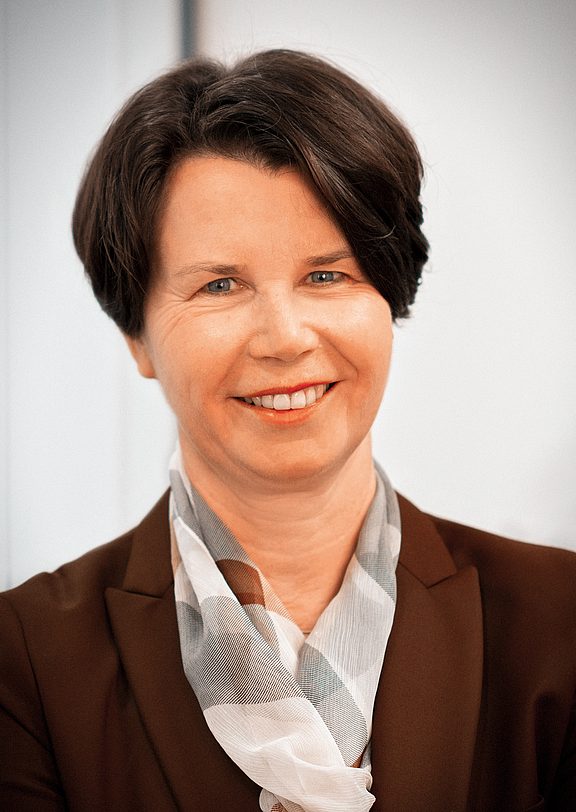
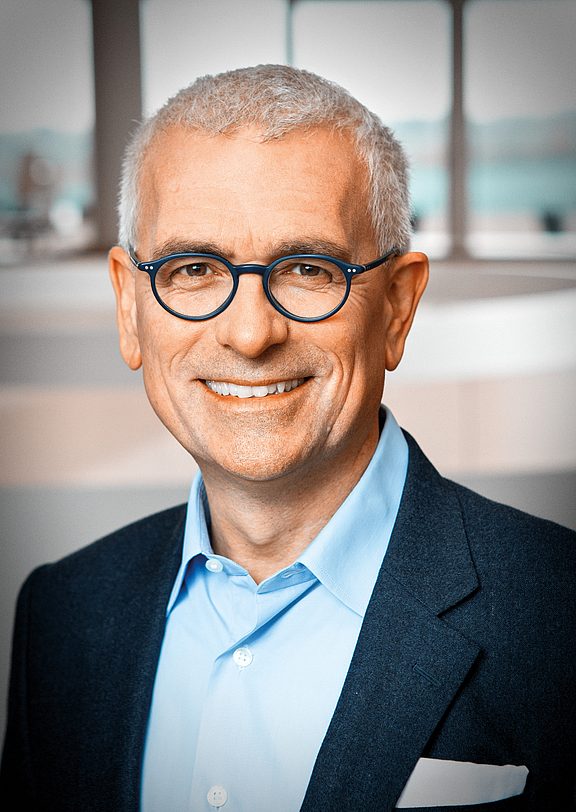
"We are in the year 50 BC. All of Gaul is occupied by the Romans... All of Gaul? No! One village populated by indomitable Gauls continues to resist the invaders. And life is not easy for the Roman legionaries who are stationed in the fortified camps of Babaorum, Aquarium, Laudanum, and Kleinbonum..." Almost all of us know from our youth the famous sentences that introduced every Asterix comic book, which then went on to tell legendary stories about a strong, witty group of people who always went their own way and thus stood up to the Romans and the spirit of the times. Historians claim that history always repeats itself, albeit in slightly different ways. And sometimes so realistically that there is no need to invent anything. Financial institutions rarely manage to attract a lot of attention with positive headlines – and not just since the financial crisis. Instead, we read about banks cutting jobs, closing branches and disconnecting from their customers. But there are also solutions, ideas, and innovations. And clever minds like Eva Wunsch-Weber and Oliver Klink. She is the CEO of Frankfurter Volksbank, he is the head of Taunus Sparkasse. And both are as unbeatable in their success as Asterix and Obelix; witty, strong, and curious, they have implemented an idea in the Taunus region that has been reported on by heute journal and other television programs, as well as many national daily newspapers and business magazines—not only in Germany, but worldwide. The merger of their branches in rural areas and their redesign into central financial centers in the digital age was ridiculed by many experts...

Oliver Klink (OK): Of course, there were also skeptical voices. Obviously, digital transformation and digital banking are unstoppable. Neither Eva Wunsch-Weber nor I want to or can stop that. But we have to operate in the here and now. And no matter what statistics we use, 60 to 70 percent of customers are hybrid customers. They are familiar with new digital channels, but they also value personal contact. That is a competitive advantage that cannot be copied, so why should we voluntarily give it up? Then we would not be doing our job, because that is what the majority of customers want in the here and now. As a service provider, it is good to give customers what they want.
How is the culture of presence digitally supported at your company?
Eva Wunsch-Weber (EWW): Without digitalization, no branch is conceivable, and without branches, no digitalization is conceivable. One customer visits the branch because he says, "I want to go digital, but I need help." Another customer says, "I've started going digital, but I'm stuck." Customer three admits, "I'm a private banking customer. I know how to use digital technology, but I want personal service." And the fourth customer says, "Guys, I want to decide what I want." And that's the key point: we have to cater to all preferences, and we want to.
Holger Meyer (HM): Why should we completely abandon a platform that still brings people together? I can do purely digital banking with lots of providers, that's up to me. But my Sparkasse and my Volksbank, and I can say this with conviction because both are my banks, have a completely different quality for me. We do a lot digitally in the office, of course. But there are simply things that you want to discuss together again. And for that, you need a space in the best or architectural sense.
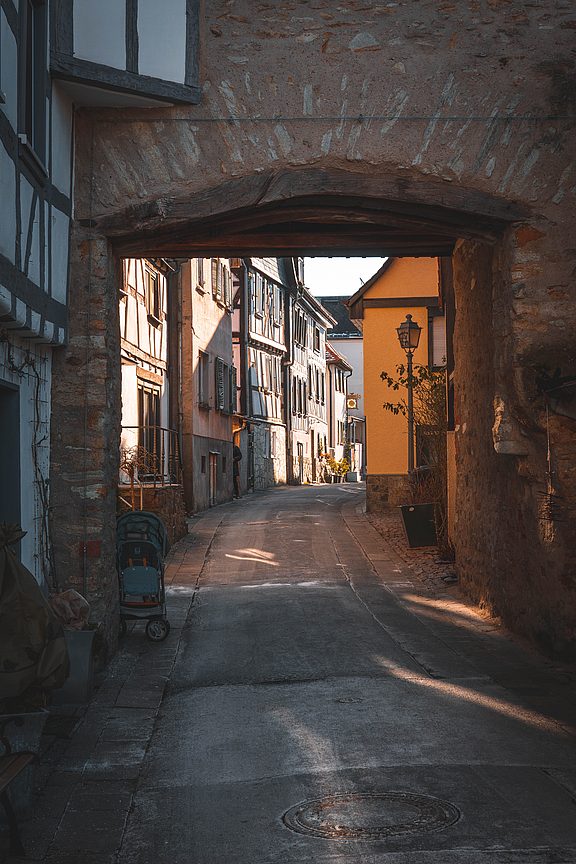
OK: And one more thing. You also have to create opportunities. We're talking about locations that aren't in the middle of nowhere. They're where social life still takes place, where people go shopping, where they move around.
What does that mean for architecture?
EWW: May I say one thing first? We had two guiding principles: Digital doesn't work without branches and vice versa. And: Customers come to us when it's important to them. The question of architecture is linked to the logic that guided us. We didn't need anything super cool architecturally, but something open, transparent, inviting. The customer has to be picked up where they actually live. And it has to be modern. And meet digital requirements. We didn't want big cabinets, no paper, but a beautiful, inviting atmosphere that reflects all of our wishes.
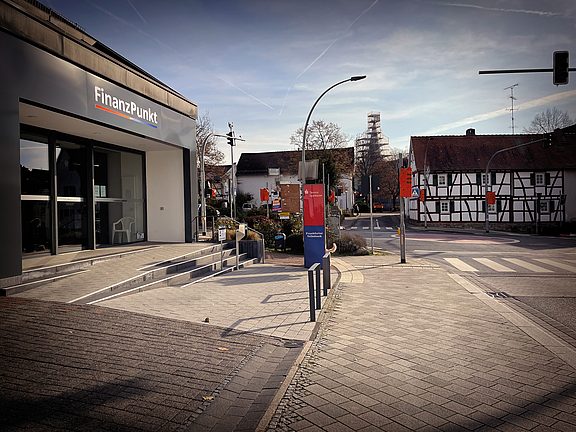
OK: So I called Mr. Meyer and explained our idea to him in a few sentences: We have locations that are old and ugly. There's still some activity there, but it's not enough for us alone. You know the idea of car sharing. We want to do that with our branches. We didn't invent sharing, we're just the first to do it in banking. A simple concept—but consistent, with its own logo, its own brand. And I think, dear Mr. Meyer, it was easy to understand?
HM: The concept was actually clear very quickly. But the design was a real challenge. Because both institutions, Frankfurter Volksbank and Taunus Sparkasse, had done quite a lot at their central locations. Each had developed a branch type that was simple, open, and customer-oriented. With a few different approaches, of course. But that's what made it exciting. Now we were dealing with locations that, if you take modern banking as a benchmark and also know the understanding of the modern branch and customer communication in both banks, were really far behind. These were branches that were not only old school, but in some cases even a step behind that. And that's exactly what we made into a theme.
OK: Mr. Meyer. That's totally unfair. It would have been wonderful to shoot 60s or 70s movies there.
HM: Exactly. Yes.
Now that the job is done, he can tell the truth...
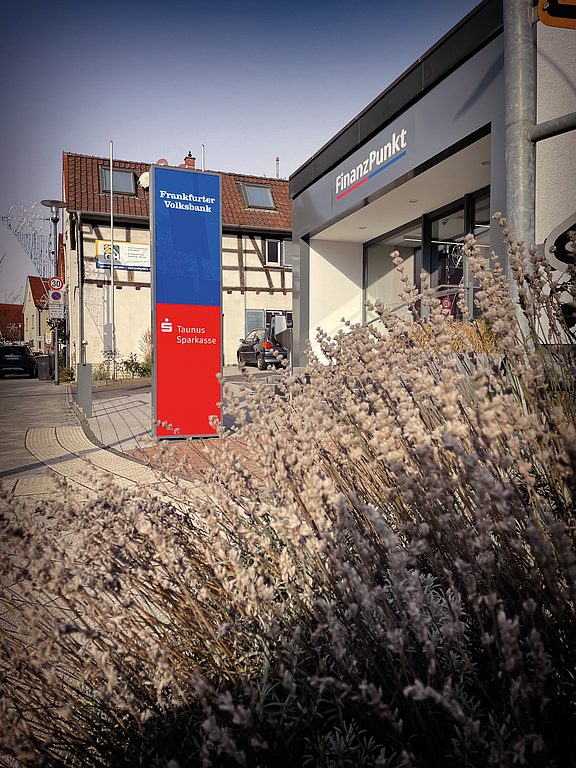
HM: The bank was protected on the outside. There were security gates and no open access points, more like a classic counter with bulletproof glass than an open customer area. It wasn't a communication space, but more of a classic functional room. That's how I would put it neutrally. In that respect, you could say we had an easy job because we knew where we wanted to go. But that's actually the art of it. And we worked that out together to a certain extent, because openness and transparency are naturally much more difficult to achieve in a multifunctional space measuring thirty square meters than in one measuring three hundred. A classic, large branch is different from a FinanzPunkt because everything has to be done in a very small space. We wanted to create proximity to the customer advisor and an inviting atmosphere for conversation in a minimal space. We wanted to remove all barriers, such as a desk behind which you sit – this led to a very exciting and stimulating joint discussion. We managed to achieve this multifunctionality well. We also had to implement double branding, ensuring that both Volksbank and Sparkasse were equally recognizable.
OK: I'm always happy when I go to a FinanzPunkt. In my opinion, the architecture has overcome a major hurdle and incorporated a standardized concept into a variety of different spaces. We basically had our shoebox that had to fit everywhere. Pouring simplicity into a concept that can be multiplied: that was a great achievement.
EWW: That's exactly what's so cool about it. Anyone can do plush, I would say. But when you convey what you think and feel to the outside world, then you've made it. And I think that's what they've achieved here. It all sounds so obvious and simple, but was it? How much courage did you need?
OK: Well, first of all, it was math. The frequency at our locations was no longer sufficient for five days a week. So the question quickly arose: If it makes sense, why don't we join forces and increase traffic? And it worked. We have more frequency at our locations today than before. There's a lot going on. And the nicest complaints we got were: "Because of the lockdown, I have to stand in line." We would never have heard that in the old branches.
Without you vaccinating or testing there...?
OK: We have a different booster.
EWW: You need the shining eyes of your employees. If our eyes weren't shining, then neither could those of our employees. And you have to be open to new things. You only need courage to overcome your fear. I believe that we are two very curious, very open-minded banks. We are still competitors, after all. And very serious ones at that. But we had to decide what we wanted. Curiosity or fear? We have curiosity and shining eyes. And that's contagious.
HM: I would go one step further and say that this also serves as a model on two levels. On the one hand, we were looking for an architectural solution for a new type of customer communication in locations where infrastructure is still available, and on the other hand, we wanted to see how a bank or savings bank can still function across a wide area in the digital age. Anyone could have done that on their own. Just like always. But the revolutionary thing was to break down the barriers and do it together. That was anything but a matter of course. There were banking associations behind it, there were people who frowned upon the idea that a savings bank and a Volksbank, as Ms. Wunsch-Weber said, serious competitors, would come up with such a model together. That is the even greater part of the model's character, which is completely non-architectural. Is the process complete with your success?
EWW: We didn't stop talking to each other on the last day of the opening of the last FinanzPunkt. That means we are always looking to see whether we are continuing to develop our institutions in the same way so that we can also strengthen the attractiveness of the FinanzPunkte with our philosophy. If one of our institutions decided to become a digital bank only, we would logically have a problem.
OK: We treat Frankfurter Volksbank the same way we treat our customers. With fairness and respect.
Coming back to the architecture: How durable is the welcoming culture in terms of appearance?
HM: I believe we have created a solid foundation. For me, the process is even more exciting than the architecture, which is only a tool for conveying an idea. It takes a timeless back seat. I think the whole thing is a social commitment. Dealing with rural areas is also a topic in our magazine: "How is the city changing in relation to rural areas?" And the FinanzPunkte are simply a wonderful example of how both companies are dealing with New Work and asking themselves: "How can we retain our customers? How do we stay in touch with them?" I believe that with FinanzPunkte, both companies have made a clear commitment and have also consciously
taken on a pioneering role by demonstrating how service and customer proximity in rural or suburban areas can continue to develop with a strong presence in the future – and that ultimately also makes a social contribution to strengthening trade and culture in these places.