Living, working, and residing in the city. On an inner-city plot in Erlangen, a hybrid urban building block is being created that convincingly complements the existing urban structures, thus creating a new inner-city multifunctional quarter.
As part of the expansion of the Erlangen university campus, an inner-city site was to be reorganized and redensified within the framework of a realization competition. The aim was to create a hybrid and multifunctional mix of urban living, mixed with office and commercial uses. The site is located in the southeastern center of Erlangen, in the immediate vicinity of the listed Himbeerpalast, the former headquarters of Siemens. Along Werner-von-Siemens-Straße, the comb structure of an existing office and administration building had to be incorporated into the design.
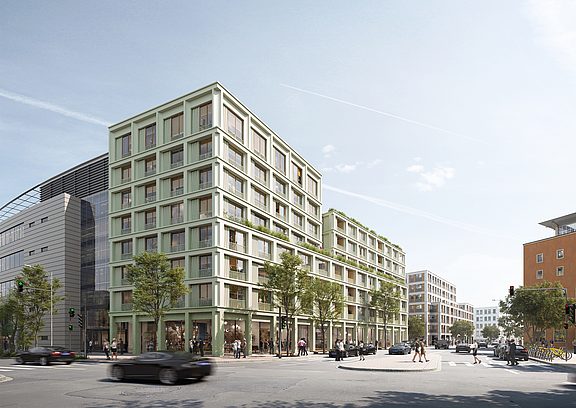
The design envisages closing off the entire block with a structurally staggered volume in the form of a U-shaped intermediate building as a perfectly fitting urban building block. To this end, the western wing of the existing building will be demolished in favor of a new building along the edge of the site in order to close off the block perimeter. By stepping down the building volume from the eight-story front building opposite the Himbeerpalast to five stories along Beethovenstraße, the new building responds sensitively to its architectural surroundings. With its geometric grid facades, the building appears tidy and clear in the urban space.
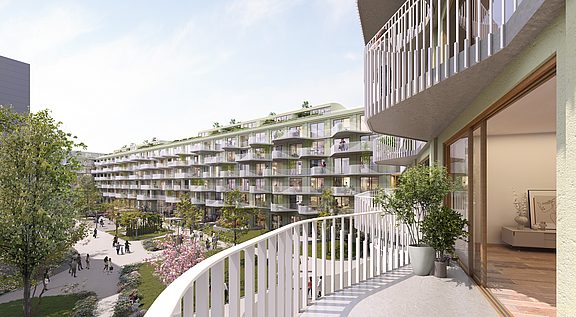
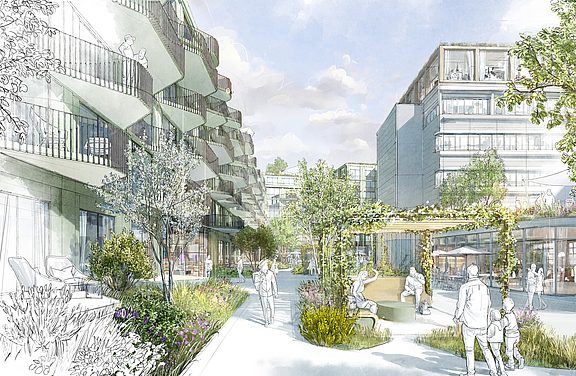
The development of the block perimeter opens up the inner courtyard as a green oasis. The contoured structure of the residential courtyard facades contrasts with the urban structure of the city facade. A wave-shaped "terrace shelf" creates private and, thanks to its south-facing position, mostly sunny outdoor spaces facing the quiet, green inner courtyard. The series of a few types of houses, most of which are open-plan and barrier-free, creates a mix of apartments with a high quality of living. Studio apartments on the ground floor allow residents to live and work in the same place. The attic apartments are designed as penthouses with roof terraces.
The inner courtyard is accessed via three entrances and is criss-crossed by a meandering public path. The two remaining wings of the existing building are being converted into student accommodation and office space. They divide the courtyard into three areas, and the spatial differentiation creates clarity and assigns open spaces to the various functions. The two wings are connected by a single-story pavilion. The café located there becomes the new centerpiece of the inner courtyard and offers a high-quality outdoor and relaxation area for residents and passers-by. Overall, the new building blends harmoniously into its surroundings, creating an urban ensemble developed from a single architectural theme.