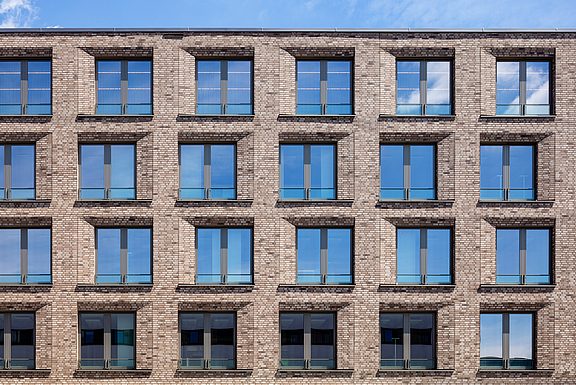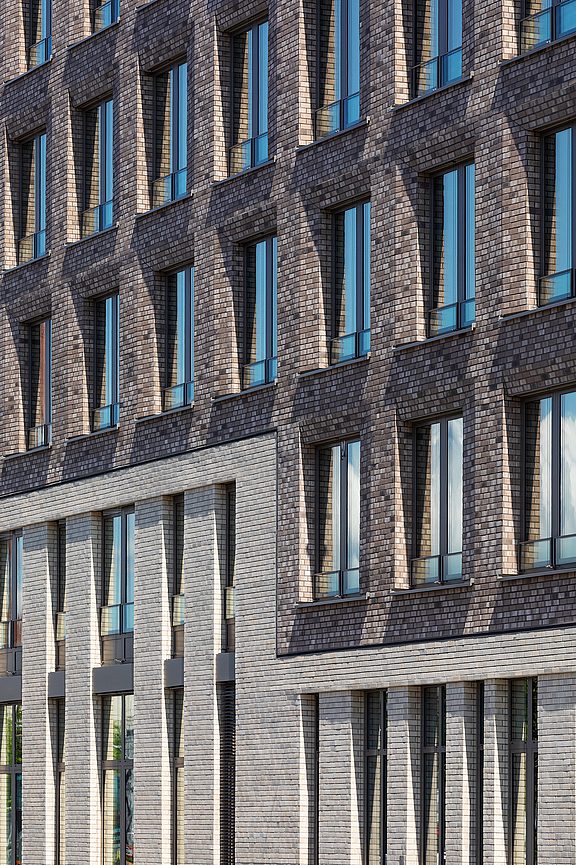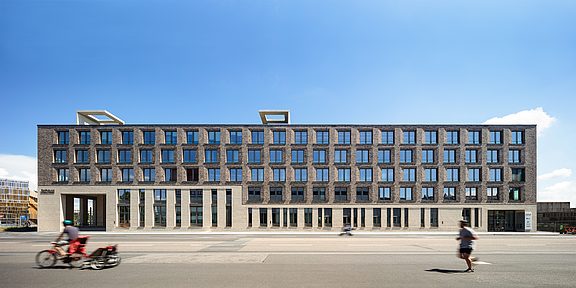
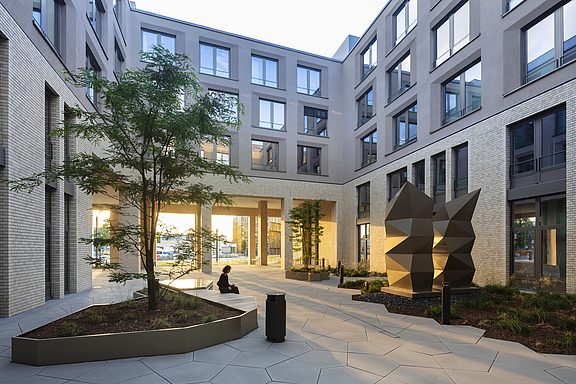
The conversion of the former customs port—called ›Zollhafen‹ in German—in Mainz into a mixed-use residential and office district is one of the state capital's most important urban development projects. The new Rheinkontor building along Rheinallee marks the architectural start of the western access to the new ›Zollhafen‹ district. The clearly defined five-story block structure with two recessed inner courtyards and 15,800 m² of gross floor area is partially staggered to four stories at the rear towards the harbor basin, creating space for sheltered roof terraces. The perforated façade made of fine clinker brick slips is reminiscent of the office buildings that once characterized the customs port. The rows of windows, arranged in a staggered pattern on each floor with flat reveals on one side, give the façade a dynamic appearance and the building its own unique look in the urban and street space.
The two inner courtyards are designed differently. The western courtyard is the address of the building, with a large incision in the volume at the junction with Rheinallee. This is where the main entrance to the building is located, via a representative two-story foyer. The second courtyard to the east is more introverted. Here, the casino's guest room, a single-story structure on the first floor, extends into the courtyard area, which also serves as the terrace for the restaurant and café. Both inner courtyard façades are plastered and harmonize in color with the clinker brick slips of the exterior façade.
The flexible office structures on the upper floors provide the basis for the creation of modern working environments. The fourth floor mainly houses the conference rooms of the main tenant, LBBW, which uses 10,000 m² of the total 14,100 m² of rental space for its Mainz regional branch, in addition to the roof terraces. There are around 180 parking spaces on two basement levels. The Rheinkontor has been classified as particularly sustainable with the DGNB Gold certificate.