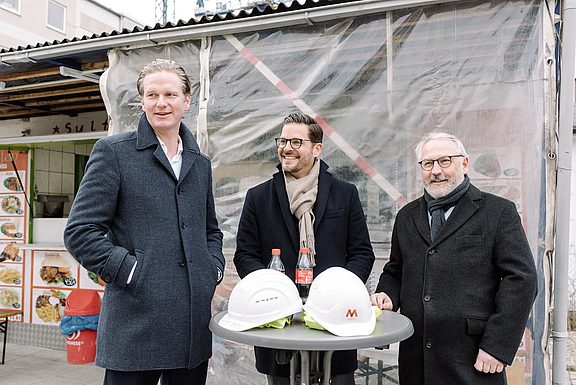
StockWerk invited the developers of three Munich construction projects to an interview tour of their construction sites throughout Munich. We wanted to know what home means to them, why they are in Munich, and what they particularly appreciate about Munich. The following applies to all three projects: No single architect is solely responsible; instead, several firms were selected for the realization. A model with a future?
WHAT IS HOME?
Joachim Schmidt-Mertens, Hamburg | Home is where people feel at home. My home is Hamburg. That's where I was born, grew up, and have spent almost my entire life – that's where I feel at home. From the perspective of our company, Becken Development GmbH, our home is not only Hamburg, but also Berlin, Frankfurt, Munich, and Düsseldorf. Everywhere our projects are located. This raises the question: Can you have more than one home? Perhaps there is a reason why there is no plural form of home. To address this, we always have employees on site who take care of exactly that: creating properties that fit into their respective homes.
Tobias Wilhelm, Wiesbaden native and Munich resident by choice |I would differentiate between home and roots. Home is naturally always associated with family. With your family, you can find a home anywhere in the world. But your roots may lie elsewhere. Mine, for example, are in Wiesbaden and Hesse. I have many memories associated with that place. But we have now been in Munich for 15 years, and the city is more than just our home. Munich has become home. Art-Invest's headquarters are in Cologne. We also work according to the branch principle and are represented in all major metropolitan regions in Germany. Our Munich branch, which currently has 34 employees, is responsible for the entire southern Germany region. In project development, it is very important to have this connection to your home and location. It is important to have people on site who are familiar with the subject matter. That there are short decision-making processes, short distances to partners, architects, and all stakeholders in a project. We firmly believe that a project can only be represented emotionally if you are also based locally. For the project developer, this means that you can only be successful in the market if you have a local connection.
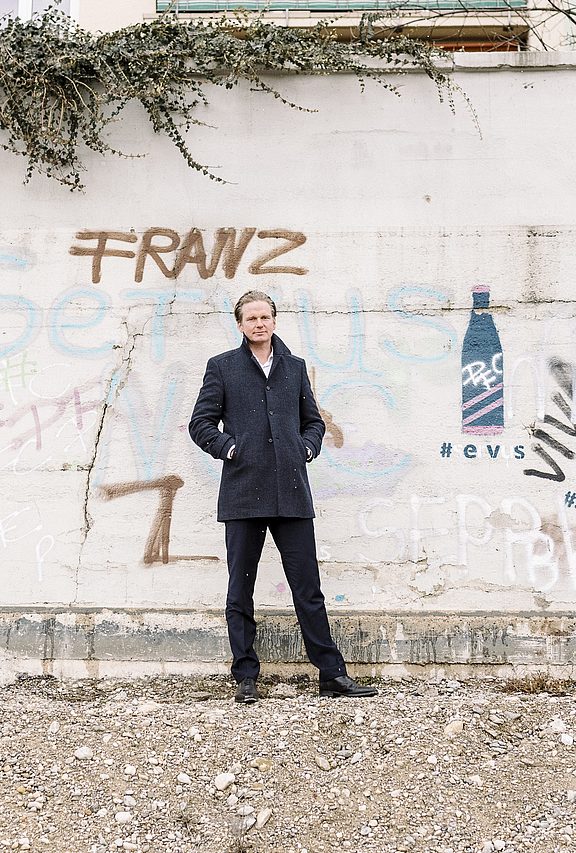
Gerhard Wirth, Regensburg resident and part-time Munich resident | Your home can change—whether that changes your sense of home, I don't know. But feeling comfortable in your surroundings has a lot to do with it. Feeling comfortable with the people there, even in urban areas. That has a lot to do with quality. You can see it happening all over the world at the moment, with many people losing their homes, and then you learn to appreciate it again. The core business of Isaria Wohnbau AG, as the name suggests, is housing, which is something that is inherently linked to home and feelings of belonging. In this respect, it is a topic that is very important to us. We purchase relatively large areas that were often previously used for industrial purposes and try to create a new home for hundreds or thousands of people there, as well as an environment where they can feel at home.

Gregor Gutscher, Frankfurt native | Frankfurt is my home. I really like Munich. So it's a stroke of luck for me that we have an office there. I used to live and work in Munich for five years and thought, well, it's still Germany. But I quickly learned that no, it's not—it's Bavaria. That was an intense learning process for me, realizing how attached you can be to familiar things. In this context, I find the term "familiar" quite fitting. Munich has not become my home in the literal sense of the word.
Holger Meyer, born in the Rhineland, lives in Frankfurt but feels a little bit Bavarian | Although I was born in Düsseldorf in the Rhineland, my roots are also in Bavaria, as my father comes from Bavaria. We always spent a lot of time here, as my mother had fled East Prussia and her homeland no longer existed for her. So I can't really limit my sense of home to one place. I've lived in Frankfurt since my youth. I have put down roots here. This is my home, even though I wasn't born here. But I don't feel like a Frankfurter, nor do I feel like a Düsseldorfer. I also have many memories of Munich, which is also a piece of home for me. I can't necessarily limit home to one place. It is this ambivalence that makes it so appealing to me. Just like our two office locations in Frankfurt and Munich.
WHY MUNICH?
Joachim Schmidt-Mertens (JSM): As a project developer from Hamburg who works in residential and office construction, I immediately see the obvious qualities: the city is centrally located and has excellent national and international connections thanks to its good infrastructure. A large airport, rail connections to and from all of Germany and Europe, and a well-developed motorway network. These are essential economic factors that make Munich an ideal location for businesses. The automotive industry, automotive suppliers, IT companies, the pharmaceutical industry, insurance companies, electrical engineering—every major player is here.
Tobias Wilhelm (TW): Munich is the third-largest office market in Europe, after London and Paris. We currently have extremely high demand for office space—and, as a result, for residential space as well. This naturally presents Munich with certain challenges. Plans for sub-centers are far from sufficient to accommodate the growth that Munich has experienced in recent years. In this regard, Munich lags behind London and Paris, for example, where development zones outside the city center were identified at a very early stage.
Gerhard Wirth (GW): Thankfully, things are happening—to be honest, it had been a bit stagnant for decades. Communication with the surrounding communities and cities, with all the Dachaus of this world and everyone around them. It won't work without them. Between 6,000 and 7,000 apartments are currently being built each year, and in recent years even slightly more. But that's still far from enough to meet demand. And now we're already stuck in the next discussion about infrastructure.
TW: Munich is also a safe city in every respect, especially in terms of the political environment. Compared to Berlin, Munich is the clear winner among other major cities. The fact that global companies such as Google and Apple have deliberately chosen Munich and are renting large spaces here speaks volumes for the city. This attractive business location is also a job engine, making Munich the most popular city in Germany for investors.
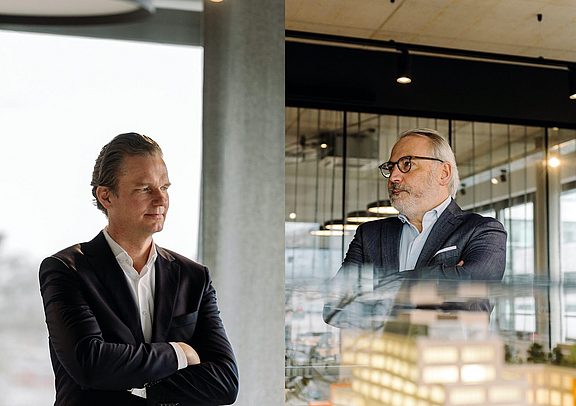
GW: Everyone likes coming here. Everyone wants to come to Munich and stay here permanently. Precisely because of the qualities I mentioned earlier, both in terms of private life and the job market. Of course, even the head of Google says: great city, great universities. Our problem as a pure housing construction company is that the trend is moving toward just trading land. We are trying to buck this trend. There is constant discussion about how building here is too expensive and needs to become cheaper. This is fueled by the fact that everyone wants to live in the city at the moment. On the other hand, there are very conservative forces here that cling to everything and don't want to allow any changes. Values are also important to us—but sometimes I think to myself: we need a little more courage!
GW: Munich is one of those cities that is really well structured on the administrative side and demands high standards in planning. Take our Diamaltpark project in Munich-Allach, in the far northwest of Munich, for example. We developed everything there through architectural competitions. This also applies to socially subsidized buildings.
HM: We mainly work in Frankfurt and Munich—in both cities, we have a very well-structured approval and regulatory framework. But that's also because we've built up trust over the years. And so it kind of comes full circle: there's a foundation in place, certain doors are open, and suddenly you can explore other avenues. Precisely because you've done things exactly as discussed many times before.
GG: For me, it is always important that architects understand what is important to the people in the place for which I am designing something and may later build. What is the attitude to life like? What are the customs of the users? But also in the city? What is it like in the planning team and at the office? All of this influences me as an architect and flows into the design. The more intensively I know or perceive the place, the more convincing the solutions become. I used to work in an international firm and co-designed a 450-meter skyscraper in China. In the end, we didn't win the competition because, according to Chinese tradition, a dragon must always be able to fly around the corner. I can find that ridiculous, or I can come to the point of seriously engaging with it. And to do that, I need to be close to what is happening culturally.
HM: That describes the local color nicely. I would never find a builder in Frankfurt with whom I could discuss combed plaster or scratch plaster. In Munich, this is a completely typical topic. It's a culture, a piece of building culture. You have to feel and know it to understand that Munich has a different building culture than Frankfurt. That has something to do with home. Creating architecture that has a connection to a place or cultivates a tradition. That doesn't mean it's not modern architecture—but you have to understand why some things are the way they are.
Understanding a place from a traditional perspective is an essential task for us architects. And you can only do that if you engage with the place. You can consciously interpret local customs differently. But to do that, you first have to understand them.
In the "Hoch der Isar" project, for example, we are also working as coordinators of the overall project and thus have an interface with our Munich colleagues. We are learning a lot from this cooperation. But you also have to listen and learn from it.
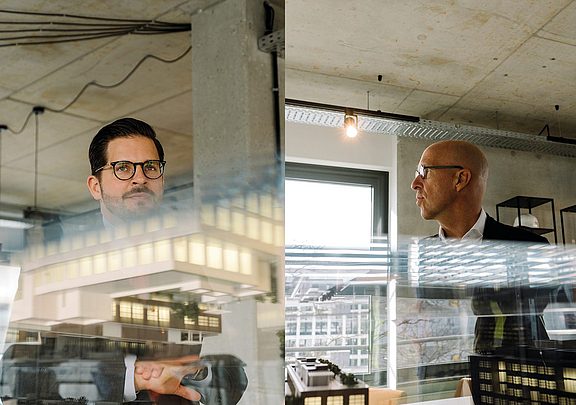
TW: The demands and expectations placed on the architectural and urban planning quality of new construction projects have increased significantly in recent years in the city of Munich and the surrounding communities. Take our project "Die Macherei" in Berg am Laim, for example: we are helping to further develop the city and create something sustainable. That is why architecture and its material quality are very, very important to us. As developers, we are aware of our social responsibility to society. We see it as part of our social responsibility to consider the architecture that is created and the materials that are used. Of course, in the current market situation, one could say that in the end, everything will be sold or marketed, but that should not be the sole objective. Quality and sustainable architecture will prevail even in weaker market phases.
HM: This works very well at the municipal level. Quality standards are deliberately kept high here in Munich—with the support of the authorities. There is the city's large design commission. This is a committee full of quality, made up of experienced colleagues. For projects such as "Hoch der Isar," there is a design advisory board, whose competence in this case was limited to the Paulaner site. This was a real professional discourse that we had to face there, and we were happy to do so.
GG: There is this wonderful story about the design of the Olympic Stadium by Frei Otto and Behnisch. At the time, a team of architects and planners who had previously only built a school with a bit of luck were commissioned to design Germany's largest sports venue. They presented the model with the "net tights" and someone immediately asked, "Tell me, can you build something like that?" Frei Otto and Behnisch's answer: "Yes, you can." (laughs) Exactly, "if you say it can be done, then let's do it."
THREE PROJECTS IN MUNICH
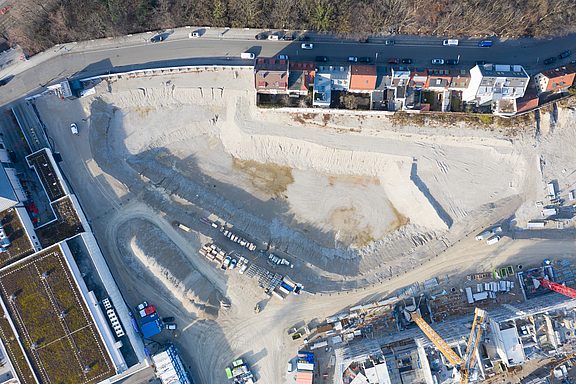
A new inner-city residential quarter is being built on the former site of the Paulaner brewery on Nockherberg in Munich's Au-Haidhausen district, a prominent location with magnificent views over the city. The urban development framework plan reflects the small-scale, green structure of the Gründerzeit district of Au-Haidhausen, which was mixed with residential buildings from the 1950s and 60s after suffering extensive destruction during World War II. The result will be a diverse neighborhood block with a total of 195 condominiums, a wide variety of apartment types, and a green inner courtyard.
"What makes the concept special is that it creates truly different types of buildings, not just different facades," emphasizes Joachim Schmidt-Mertens, managing director of Becken Development GmbH, in an interview. According to Schmidt-Mertens, the expectations of the city and the design committee were even exceeded: "There was a comprehensive design guide, but we did even more. In many areas, however, we followed the city's suggestions – that made the project very high quality overall."
In 2017, Becken Development GmbH acquired the most exclusive building site along Hochstraße and commissioned three renowned architectural firms to develop it. In a workshop process, the specifications of the urban development concept were implemented and a chain of 13 residential buildings was developed. Together with the existing row of houses along Hochstraße, they form a block. This has resulted in buildings that vary in character and size, which is reflected in a lively alternation of facade types – clinker facade, plaster facade, natural stone facade, precast concrete elements.
All buildings comply with the design guidelines for the neighborhood. In order to meet the requirements for a mix of housing types, smaller residential units are being built on the lower floors. The larger apartments are located on the upper floors. The attic apartments have spacious terraces. The entire neighborhood is built on top of an underground parking garage with 210 parking spaces, which are directly connected to the apartments. holger meyer architektur is planning four residential buildings and is also coordinating the overall planning of the approximately 18,000 m² project.
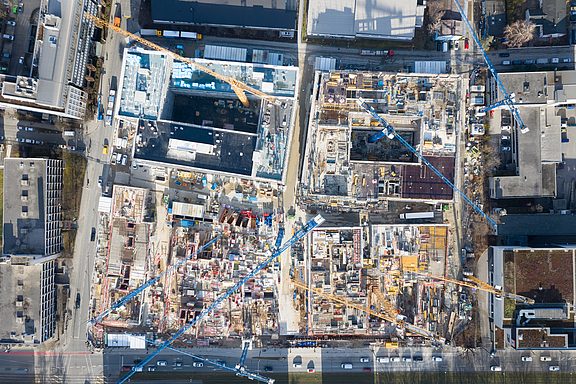
Die Macherei is a neighborhood development project by Art-Invest Real Estate in collaboration with Munich-based Accumulata Real Estate on the former site of the Temmler pharmaceutical company in Munich's Berg am Laim district. At the end of 2016, the developers and the City of Munich held an architectural competition among eight internationally renowned firms: Holwich Kushner from New York, Ochs Schmidhuber Architekten from Munich, and holger meyer architektur are designing the urban office and commercial district.
Characterized by raw materials, industrial-style elements, and striking silhouettes, the architectural language is reminiscent of the brickworks that were once located in the district and connects the diversity of the individual buildings.
Both buildings planned by holger meyer architektur, with loft offices and retail space, will each have their own distinctive design signature, inspired by the loft and industrial buildings of the Wilhelminian era. The industrial-style "Nachtkastl" structure, standing on supports, creates a charming connection between the two buildings.
For inspiration and to create a cosmopolitan mix for this location, the developers and architects even went on a three-day excursion and inspiration trip to New York.
The aim was to create a neighborhood that would also benefit the surrounding area. Half of the site will be accessible to the public. A gym, restaurants, and retail outlets will ensure that the neighborhood has a diverse mix of amenities. The ten-story tower will house a hotel, whose operators will also run a restaurant concept on the ground floor. The six buildings will have a total gross floor area of around 74,400 m².
Themed terraces enliven the roofs
In addition to the heterogeneous architectural language, a special feature of the project is the roof terrace landscape. Tenants have access to over 5,000 m² of space for a variety of uses – in addition to classic terraces, there is also open space for active people: a basketball court, a tartan running track, and rocks for bouldering on the technical structures. Urban gardening is also a theme, as is a rooftop bar with a view of the Alps on the hotel.
"Our aim as project developers is to give our users maximum flexibility. Floor plans that are flexible and can be freely designed – whether it's a cell, an open-plan office, or perhaps even a combination of the two," explains Wilhelm. "That's why we made a conscious decision to bring in a co-worker and thus provide a swing space."

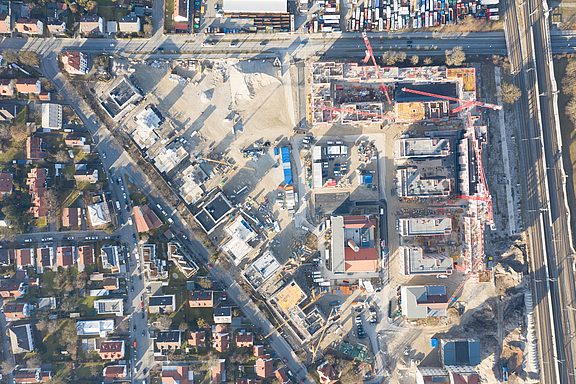
From baking aids to soup seasonings, the products of Diamalt AG, once a traditional food manufacturer from Munich, were a staple in German households. The former factory site in Munich-Allach covers 85,000 m². Here, Isaria Wohnbau AG is developing a mixed-use residential quarter interspersed with listed industrial buildings under the name Diamaltpark. Based on an urban development and landscape planning competition decided in 2015, more than 720 apartments in three- to six-story buildings are being built in six construction phases, 120 of which are hybrid timber constructions. One-third of these are subsidized housing units. In addition, three new daycare centers are being built. The individual construction phases are being planned by different architects to ensure design diversity.
The site contains several listed industrial buildings, some of which will be used for public purposes and some for private purposes, and which were sold to private investors during the course of the project. The renovation of the buildings is taking place in close coordination with the historic preservation authorities. With public functions such as a café, they are once again becoming elements of the neighborhood that create identity and remind us of the history of the place. But they are also becoming elements of the entire district, which the Diamaltwerke shaped for over 100 years.
However, the history of the site and its use also brought problems with it: the previous industrial use contaminated the soil. The busy Munich–Nuremberg ICE railway line to the east caused increased noise pollution.
The KraussMaffei tank testing ground behind it also had to be taken into account in the planning. The rows of houses along the railway line form a shell development with only a few window openings facing the railway line. The neighborhood opens up inwardly toward the center, where a public park is being created as the central neighborhood square. The soil was decontaminated before construction began.
holger meyer architektur is planning construction phases DIA1 and DIA2 with a total of 310 residential units. The main focus of the planning was on addressing the special features of the old industrial buildings and the identity and history of the site. The result is a lively architecture with large window openings and loft styles. A design that ties in with the listed industrial buildings and references the character and history of the site.
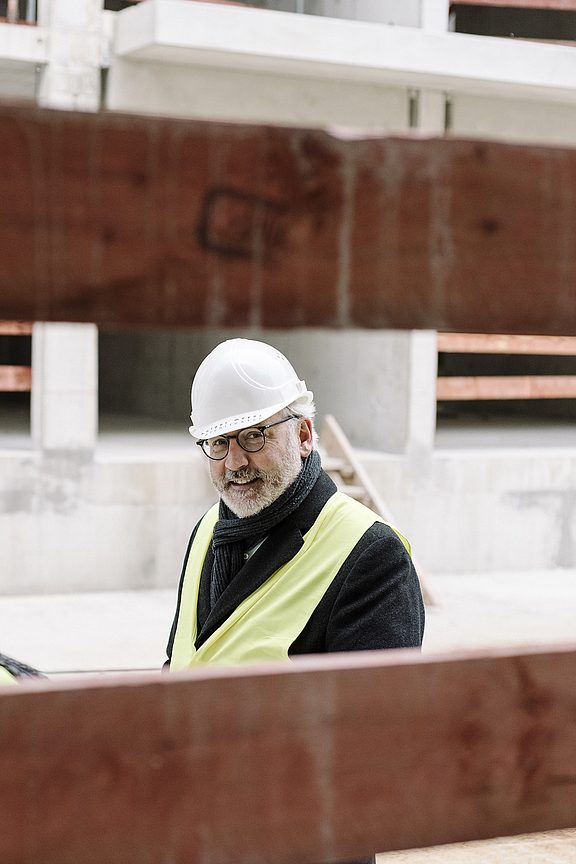
"I grew up at a large construction company in Frankfurt. My first boss advised me: 'If you have a renovation project, calculate it very carefully. When you think everything is finished, multiply the result by two.' The owner of the boiler house said to me: 'With my experience today, I would say multiply it by three.'
GERHARD WIRTH