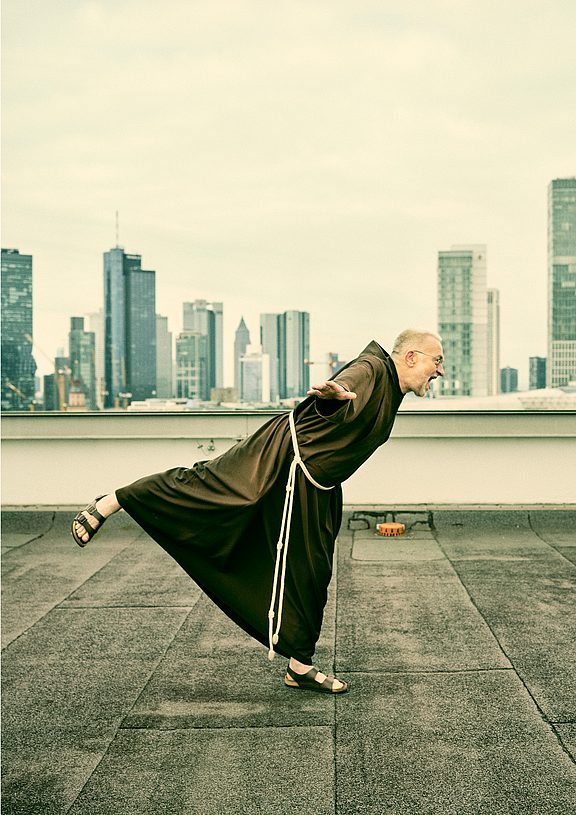
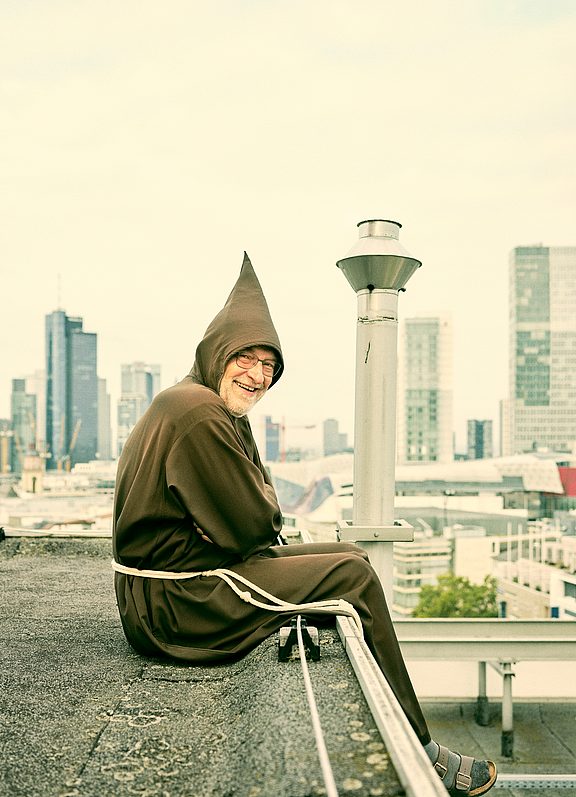
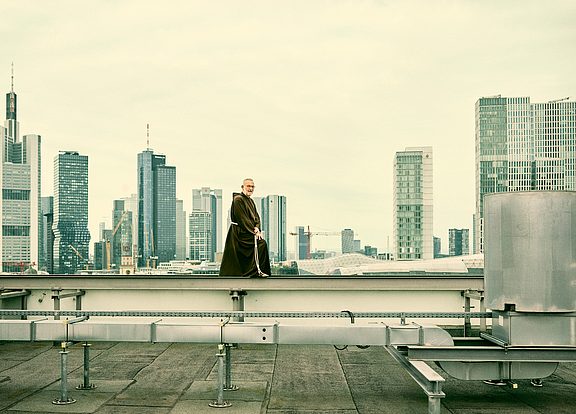
What was it like on the roof of the Frankfurter Sparkasse?
Brother Paulus (BP): Very nice (laughs).
And what did you see from the roof?
BP: Well, for one thing, that we have a lot of people in Frankfurt who want to reach for the sky. People who have career aspirations and would like to be at the top. And at the same time, there are also many who are at the bottom. So I thought about fulfilled dreams and shattered ones. And then I asked myself how cohesion can grow in this city. How new meeting places can be created.
Holger, what role do meeting places play in your planning?
Holger Meyer (HM): The benchmark for new plans is always the quality we know from our environment in the grown city. Meeting places that have a spatial quality, where we like to spend time, that are green, that are well lit, and so on. But when it comes to planning, the selfishness of each individual also comes into play, and that's a difficult point. We once planned a large residential quarter in Düsseldorf. At a town hall meeting, there was great resistance to a public park that we had planned as a meeting place. One resident loudly protested that everyone already had their own garden. He didn't care about the environment of the 800 new apartments. This example shows how planning processes work and how deeply rooted this inner selfishness is.
Brother Paulus, you once said in an interview: no decision without ethics. What are the parameters and what should be the guiding principle, even in economic activity?
BP: Ethics actually encompasses all the reasons that prevent us from becoming victims of profit. The common good must always come first. But I am also a realist. Every Saturday in front of the Kleinmarkthalle, I observe people who would all say that they are highly ethical individuals—yet with a Rheingau Riesling in their hands, they leave their trash lying on the ground. On Sunday mornings, it looks like a pigsty. Then I ask myself how we can respond to this, for example, with more trash cans or toilets, preferably with staff whose wages are included in the price of the wine. In other words, everything that creates a pleasant atmosphere. Of course, urban planning is not an education program. But we need offerings that remind us that we are a shared city.
Do spaces create respect?
BP: Yes, we have our homeless breakfast here in rooms with high-quality furnishings. We have never experienced any damage. The furnishings radiate an atmosphere that people automatically find appealing. I believe that when something valuable is created, people are also reminded of their own value. That's why architecture used to be designed to be beautiful. So that you don't just pour concrete somewhere and install a cheap door, but give the impression that people have put a lot of effort into it.
HM: I call that loving architecture. Modernism has actually killed what makes things lovable, interesting, and varied to the eye, and the quality of the surface and the material has also been largely lost.
BP: Does architecture always have to be square, practical, and good, as in Frankfurt's Europaviertel, for example? It's probably cheaper because it's pre-fabricated and looks like it came off the rack or from Aldi?
HM: Although the Europaviertel is a good counterexample to this thesis: even if it seems that way in some respects, it is by no means all inexpensive architecture.
BP: Yes, exactly, but still—when you drive through it, it's one of many soulless places I know...
How difficult is it to convince investors of the value of thoughtful architecture?
BP: Well, I think Norman Foster's concept for Commerzbank, with its world gardens and natural air conditioning, is based on a vision and a great deal of passion. When I enter the headquarters, I sense an atmosphere that is good for people. After all, the economy can only benefit from thriving people. The term "purpose" is on everyone's lips right now. But it's clear that people want to do meaningful work in a suitable workplace and would prefer to live in a city that is intelligently and humanely planned.
HM: I also believe that investors can now be enthusiastic about this. Because it is sustainable in the best sense of the word and creates structures that simply function as urban space for decades.
Is there an even greater risk that beautiful architecture will fall by the wayside if, following the federal elections, the goal is to build at least 400,000 apartments per year? Will the aesthetics of life be forgotten in the rush to create housing?
BP: Let me put it in political terms: it's scandalous that the city planning office is not required to work with the cultural office. The woman whose husband is being laid to rest in the cemetery has to pay extra for every laurel tree because the cemetery is run as a private enterprise that has to operate economically. But when she goes to the opera, her ticket is subsidized by eight hundred euros. Burial is also a cultural asset of our society that is part of our lives and should therefore be publicly funded. So there should be no urban planning without cultural experts, otherwise we will end up with museums on one side and apartments on the other. Why don't we have more creative spaces and things like that? A museum in the middle of a neighborhood? Why isn't there a local museum? Residential neighborhoods are often degraded to sleeping quarters and are by no means places where I can live together with others.
If you were standing on the skyscraper again in ten years' time and had a dream, what would you want to see?
BP: Oh, I would want to see that above the boardrooms and the top floors of the high-rise buildings, there are one or two more floors added, where there are spaces for meaning, where there are cultural gatherings, where there are attractions, where people can lift their spirits so that they can go through life with a spring in their step again because they have come a little closer to heaven.
Thank you very much for talking to us.