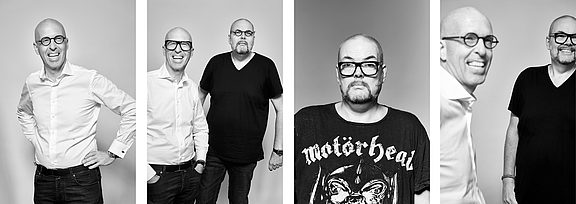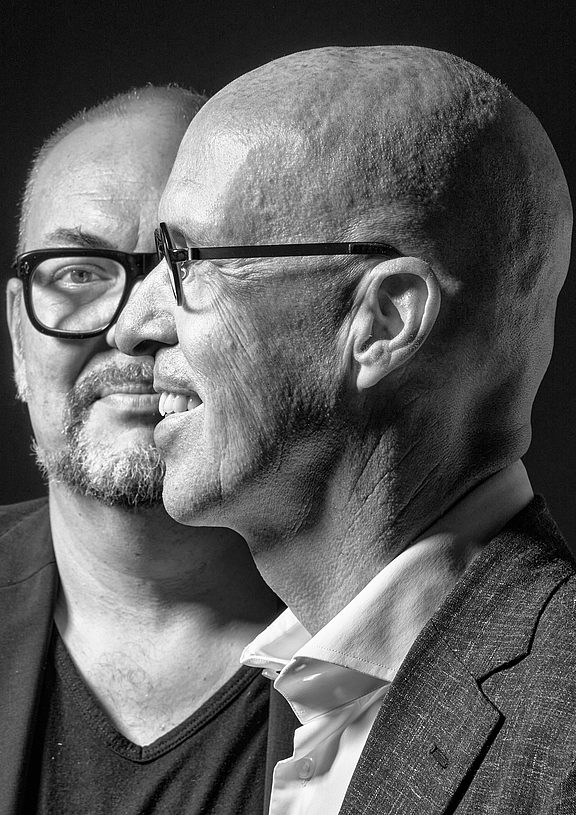
This is the third issue of your magazine StockWerk. How do you architects feel as publishers—and why did you become publishers?
Holger Meyer (HM): Architects tend to present their world in beautiful images—and I don't want to exclude ourselves from that. These beautiful images develop their own aesthetic, which is entirely justified. That's our profession. That's our passion. But from our point of view, it's also too short-sighted. Because architecture is much more than a beautiful image. Architecture exists in a context that we want to illustrate with StockWerk: So why do we do architecture? For whom do we do architecture? With whom do we do architecture?
Gregor Gutscher (GGU): Or rather: How do we work? What interests us? It's not just architecture. Ideas always come from God knows where. At the very beginning of my studies, a friend at the time asked me, "Tell me, are you worried that you'll run out of ideas at some point?" The answer was quite simple: "No, I don't see why. The field from which ideas develop is huge. In fact, it's infinitely large."
What defines your work?
HM: In short: listening and understanding. It's not an isolated process. I can come up with something creative on my own. It might be beautiful and it might be right in my world—but then it's just an image.
GGU: And then you're "just the artist."
HM: Yes. But we look for the contextual connection. And we can only achieve that if we understand: Who is sitting opposite us? What does he or she want and why? And what might the joint path to the goal look like?
GGU: Architecture always has something to do with society, with lots of people who ultimately have to use what we build every day – or are allowed to (laughs). It's always a process in which you have to bring together many different aspects.
HM: For me, this is also change management in the process. A new corporate or company headquarters, for example, is a radical change for a company because it can bring about a cultural shift in how people interact with each other. And this whole process, which, incidentally, is underestimated by many, is an exciting task for us as mediators. A journey with an initially uncertain outcome. And what is actually the focus? Let's stick with the office example: How does it become an architecture that people can identify with? How does the balance between functionality, clarity of concept, and design standards, etc., develop?
GGU: And emotionality.
HM: Emotionality—how does my workplace function in the context of my overall life model?
GGU: Do I like it?
HM: Do I like it? Do I want to go there? I spend more time there than at home. So, the signs have changed dramatically. We come, if you will, from the functionalism and brutalism of the 1970s and 1980s. Back then, office buildings were machines. They had to function. They had to be efficient. They had to enable optimized processes. They had to be as modular as possible. Today, the signs point much more toward work-life balance, quality of stay, comfort, and a sense of space.
GGU: Yes, of course.
HM: We had this discussion here in the office—we wanted to create an environment that people enjoy spending time in, but that doesn't try to be a "replacement home." Our colleagues aren't a replacement family, but we wanted to create a feeling of well-being that was as balanced as possible. That's not so easy, and it's different for every company and every type of work. There's no right or wrong answer. Through our work, we see the direction this is taking at different companies. There's a lot going on right now. The problem is that the managers who initiate or accompany such processes may not even know whether they will still be with the company when the building is finished.
It's a bit like politics. You look at a company that is currently undergoing an incredibly dynamic process, and we have to create structures that can reflect these changes in the future: How will we work in the future? How many employees will work from home and for how long? We are currently discussing these issues. Will we work more in teams and groups? Do we need more quiet rooms so that we can carry out individual tasks in peace? Do we need very small meeting rooms with a large screen, because we only go in there in pairs to talk to someone who is participating virtually from somewhere else? We used to build conference centers with lots of large rooms for lots of people. But then there would always be three people sitting there looking lost. So we said: Just build club rooms and put armchairs in them, like in a fireside lounge. That way, you don't have a huge table for a staff meeting where two or three people sit and create maximum distance—instead, you sit comfortably next to each other, like in a living room. We've done this at many law firms because it creates a more relaxed atmosphere for discussions. These are small details that describe planning tasks and discussion processes well.
GGU: Another example to illustrate this: Why do we all like old apartments? Because old apartments don't necessarily have a fixed layout; they just work. Bedroom? Children's room? Living room? In old buildings, you can choose freely. Even down to: Where is the kitchen and where is the bathroom? Because the bathroom wasn't originally planned. It was outside on the landing. And that means that these apartments can be interpreted flexibly. If we're only talking about functionality, we have to be careful that it's not just about circling workplace guidelines and standards, but that the concept is flexible and, if possible, creates a strong emotional anchor.
How we think. How we work. How we tick.
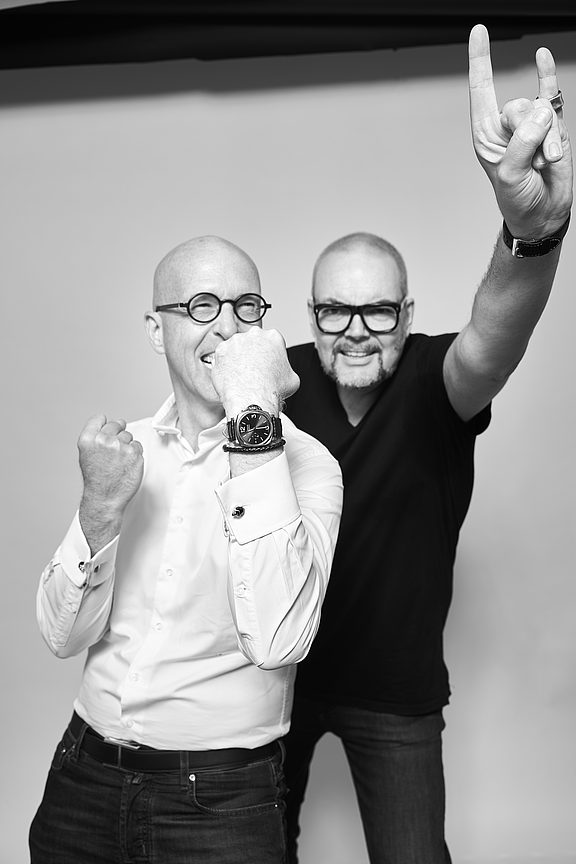
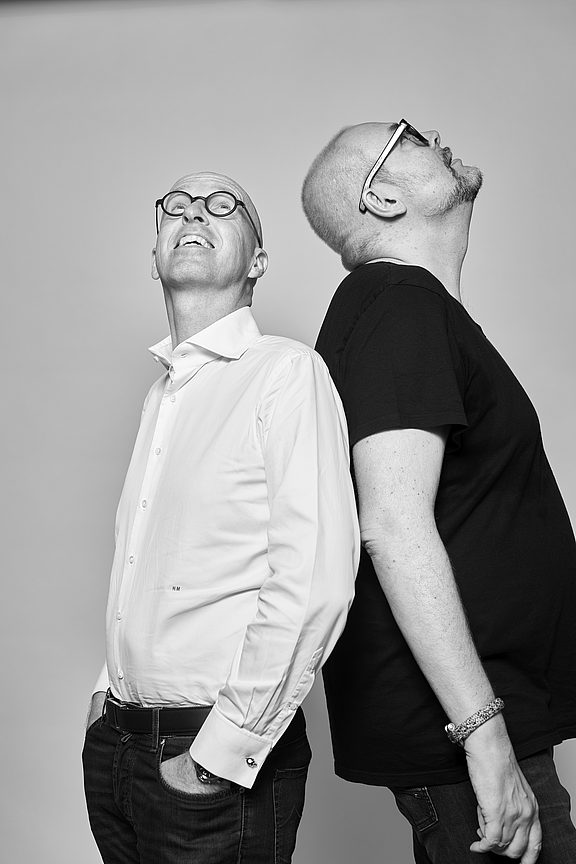
How far into the future do we need to look? The current issue of StockWerk has "city, country, green" as its central theme. What role does sustainability play in your work?
GGU: I would like to see sustainability defined differently. Has the topic of green building, as we know it, been thought through to its logical conclusion? The essence lies more in the question of what structure the building itself has. How many underground parking levels do I still build today, for example? At the moment, people still want garages—at least in office buildings, for marketing reasons. But we all know that in ten or 15 years, hardly anyone will be asking for them. So we need to think more in a social context, more about the future. However, we also notice that awareness of sustainability has not yet reached the construction industry itself, because we often still think too much in the here and now.
HM: Nevertheless, I am very positive. We know where we need to go.
GGU: Yes—I think so...
HM: More and more people are realizing that this is an irreversible path. And it is simply being enforced by economic parameters. Fifteen years ago, we started certifying buildings according to ecological and energy quality standards. At first, no one did this because investors said, "No one will pay me for that." What has happened in recent years? The big corporations, the big tenants, have all said, "We won't move into a building that isn't certified." This has led to changes in real estate development. Now, uncertified buildings that are less than ten years old are being sold because tenants are moving out. The next step is for all companies to commit to complying with ESG standards. And these are even broader in terms of social responsibility than building certification. And I believe that the coronavirus pandemic – as absurd as it sounds – is accelerating the process.
GGU: Because workplaces are changing and we are thinking about different buildings and structures. We currently have incredible momentum in these processes.
HM: Germany is lagging far behind in the digitalization of the construction industry. But this is the key to truly sustainable construction. We in Germany will therefore emerge from the coronavirus crisis with little new knowledge in technical matters because we are simply too slow. That is also the reason why we are simply lagging behind in some technological processes. And unfortunately, this is also the case in construction: we always set the bar so high that only a few can jump over it. And that simply makes construction extremely expensive. But there are good examples in other countries.
GGU: In the Netherlands, buildings are increasingly being cataloged: it is known what materials were used in their construction. And this can then be used to calculate a residual value. Of the 67 million invested, 22 million remains in material value, which can be resold in some way. And then the whole thing suddenly takes on a completely different value. Then I suddenly have the opportunity to say: Okay, the house can cost 77 million because I know that I can somehow book 22 million of that on the credit side. That takes things to a whole new level. And we are still relatively far away from that in our planning, at least in Germany. I can't think of very many examples.
Finally, a personal question: In one photo, Gregor, you are wearing a Motörhead T-shirt. Was that a coincidence? Is that part of your musical passion? Is it a source of inspiration?
GGU: Music is extremely important to me—it's like an emotional pendulum. I'm not a heavy metal guy, but I like Lemmy from Motörhead, who died too young. The man had incredible facets. He was interested in everything and open-minded—in addition to drinking whiskey and cola, he also enjoyed tango dancing and old English etiquette school. And then he knew all the lyrics to Abba songs and considered Phil Collins one of the best drummers in the world—yes indeed.
What T-shirt would you wear, Holger?
HM: Honestly? I'm not really a T-shirt kind of guy. But what has always shaped me is looking left and right. I feel totally comfortable in my architect bubble, but I also like to leave it, especially in my private life. I'm interested in friends who do things other than architecture. I just want to know, I want to understand, and I'm always curious about how the world around me is changing. My motivation, my source of inspiration, is actually always everything that happens beyond architecture. How do two architects like you two communicate with each other? How do you complement each other?
HM: We actually have a relatively high success rate in terms of consistency in communication. Sometimes our colleagues laugh because we spontaneously say the same things at the same time. They are sometimes expressed in a slightly different way, but at the same time.
GGU: Word-synchronous.
HM: Word-synchronous.
A nice closing remark. Thank you.