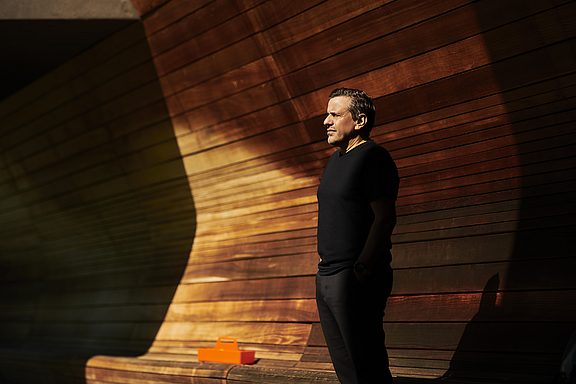
The pandemic radically changed the way we work. Within a very short time, millions of people swapped their office workspace for the dining or kitchen table at home. Even banks, whose business model is based on confidentiality and security, sent their employees home with their laptops. And many of them stayed there for the time being, coming to terms with the new reality, which was often more comfortable but also more challenging. This was a reality that office furniture manufacturers also had to deal with suddenly. Formerly trendsetters and opinion leaders in the world of work, they were suddenly driven by an unforeseen development that acted as an accelerant in many areas and continues to have an impact today. To take a comprehensive look at the topic, StockWerk met with Raphael Gielgen, Vitra's trend scout for the future of work, at the Vitra Campus in Weil am Rhein to discuss the outlook for tomorrow's working environments.
Elon Musk, multi-billionaire and owner of SpaceX, Tesla, and Twitter, recently said on the subject of working from home: "Let them pretend to work somewhere else, but not in my company." After two years of the pandemic and the trend toward working from home, are the big tech companies in Silicon Valley bringing their employees back to the office?
Raphael Gielgen (RG): For me, these and similar statements from Silicon Valley are just knee-jerk reactions to a specific situation. I don't think they will last. Just as work has been organized in times of digital change, with mobile or cloud first, work will now be organized in the context of "remote first." That doesn't mean the office will disappear. But it does mean that, for companies, it will initially be irrelevant where people work from. "Remote first" will be the imperative of a new era of work, and I'm going to venture a prediction: as things stand today, we have 1.7 million jobs that cannot be filled by qualified candidates. In the future, a company in Hamburg will not look for and find an employee in Hamburg, but somewhere else. That will be the next stage, which will then expand the ecosystem of physical work again. And you can take that story even further. We may spend another two years discussing it, but looking back, the pandemic has detached knowledge work from its physical location. Overnight, we were able to complete 85 percent of all transactions from home. And it worked. And those of us who witnessed this suddenly felt a greater sense of flexibility and freedom. For the first time in a long time, we were once again in control of our own time. And no one is going to let that be taken away from them.
Holger Meyer (HM): But we are also seeing a voluntary return to the office. I believe this is based on a desire for exchange, community, and a longing for genuine social contact. This may be an emotional overreaction. Just as we were sent to work from home from one day to the next, from my perspective, the urge for the social structure of the office now prevails. This is also because, for many, working from home is not compatible with organizing family life. How do most people work at home? What happens when the children suddenly come home from school and the kitchen can no longer be used for a meeting because someone wants to get to the refrigerator? Not everyone suddenly has a larger apartment just because they work from home. And companies will not be willing to set up and maintain two workplaces. But yes, it's true, we've had a process imposed on us with a turbo accelerator, and we're not going to turn that back.
RG: We're just starting to try this out, because for the last two years we had no choice, and now we have it again. There are companies that allow their employees to work from anywhere for a month because the company has a branch there and it's tax-efficient. And there are also employees who are very likely to enjoy coming back to the office every day because they simply don't have the necessary environment at home. But we now have the choice, and that's a win for everyone.
HM: During the pandemic, physical distance became completely relative. Our office in Bucharest is integrated into our project work here; before Corona, it was always far away. And from one day to the next, that didn't matter anymore. It didn't matter whether you were sitting 300 meters away in your home office or 1,500 kilometers away in Bucharest – we were all working on the same model. That's the real story.
Will we all be working in the metaverse at some point?
RG: Not everyone, but the metaverse is also one of these virtual spaces. I estimate that in less than five years, we will see a multiplication of the quality of experience in the virtual world. If anyone still thinks they have to continue stacking identical floors on top of each other – no connection under that number! That's a dead end.
You once said in a lecture that when it no longer matters where you work from, architecture will experience a renaissance. Is that what you mean?
RG: Yes, exactly. That was before the pandemic. It will happen. What I don't believe is that it will be a kind of "glossy architecture" like that of the beginning of the millennium. Back then, buildings basically all looked the same, inside and out. There was a technified style.
HM: The architecture of the time was monostructured. Today, there is much more going on, and not just at the architectural level. We have to think about this in new terms and ask ourselves new questions: "How does our city function? What is happening around our workplace, how is it connected to our lives?" This discussion had already begun tentatively before the pandemic. But now we are talking in completely different, much larger dimensions: Which areas in buildings are accessible to the public? And which ones serve as private retreats? Which areas enrich the social life of the city as a whole and not just the company? This is a stronger intertwining of architecture and society. We call this hybrid use, and it will change architecture massively, especially in city centers. But then there are also new areas of tension: What will happen in the future to locations that are in the middle of nowhere?
RG: That's where the mistake lies in product development. And I ask myself: How could this happen? How did this slip out of the architects' hands? That will now become history; everyone is reorganizing themselves. I can see that developers are thinking very critically about the kind of products and ideas they will use to position themselves in the future. They can no longer just develop a building; they have to think about what it stands for. In what context is this developing and what are my positions on these issues? How does my business affect society, the neighborhood, and the environment?
HM: This has developed in parallel with the pandemic: the EU Commission's Green Deal and the ESG issues it includes, which have a direct impact on financing. This caught the industry relatively cold and means that financial products are no longer being optimized, but are being driven to the political level. These are completely new experiences that everyone is currently having to learn to deal with. And that is truly a Herculean task that is currently pushing its way into architecture and completely changing our mindset. Priorities have shifted completely overnight.

And how should companies position themselves in the future to get their teams back into the office?
RG: Going to the office now, no matter which company, feels bad because the offices are half empty. And that is, of course, an untenable situation. It also makes no sense. What do we do with all that space? We heat the whole building, maintain it—invest a lot of money. Sitting on a half-full train is great, but no one wants to go to a half-empty office—it just feels wrong.
RG: But I also understand everyone who says they don't want to go to the office every day anymore. First of all, we need a cultural transformation in which we renegotiate the way we work together in a personal context. This means agreeing on certain days when we will all be in the office together. But not to check emails or sit in calls for hours on end – that makes no sense at all. The time spent in the office should correspond to the physical presence that is really necessary. We have to face this reality. That means reorganizing the way we work and thinking more like the Bundesliga. Match day is match day, and then the stadium is full. And companies need to reinvent this kind of match day for themselves. A company like Deloitte is currently following this pattern with its new offices in Frankfurt and Düsseldorf.
HM: So none of them have fixed workstations anymore...
RG: Exactly, they don't – they've been completely eliminated. They have completely abolished the office requirement. But they don't have the problem of employees not wanting to come back because the architecture is highly conducive to business. At Deloitte in Frankfurt, you enter a completely reimagined office world: you walk in and there's a lobby like in a hotel. On the right is a restaurant – it looks like a restaurant, on the left is a conference room – it looks like a conference room – and then you take the stairs to the first floor, where you have the team work areas, designed like a hotel – behind every door is a team work area. So you arrange to meet your team on one of these floors to work together. Each floor has a kind of floor manager who takes care of everything. The restrooms are clean, coffee is available, drinks are available, food is available – everything is always there. That means you come there, you're with your colleagues, and you can get down to business. If someone needs to do some deep diving or deep work, they can retreat to so-called "kemenaten" – quiet and focused. If this is implemented consistently, it works.
HM: Although both Düsseldorf and Frankfurt are conventional buildings from an architectural point of view, and they are not located in particularly attractive surroundings.
RG: That's proof that it works when you put all your eggs in one basket and play them right. Of course, it would be even better in the city.
You have to think in extremes to understand the spectrum.
RG: But the spaces are actually getting smaller. And then people will probably work in rented satellite offices. This is uncharted territory we are now entering. There are no reference points, and we will be gaining new experiences every day.
HM: Over the past two years, we have definitely learned that there are tasks in the office that we can do very well virtually. And there are some that can be done remotely if necessary, but they're no fun that way. For example, I don't do any more competitions when my acquisition team isn't in the office. Designing is a creative process. I don't think you can develop or design a car virtually via "Teams," or that the creative pool here at Vitra can function when everyone is just sitting in front of a screen.
RG: People were often here in the office even during the pandemic. Nature magazine researched this topic: there is a convergent and a divergent phase in projects. When gathering ideas, in the conception phase, it is of course better to work together as a team in person, with pens, quick brainstorming sessions, and so on. That's where the important decisions are made. But in subordinate divergent phases, where you only have to make decisions in detail, the whole thing can also be done remotely on the computer.
HM: That's right. The infrastructure is there, so much has happened technically. Living what we are talking about here now is the hurdle. And that is definitely a task for society as a whole; it cannot be solved by companies alone.
RG: But it has to be put into practice in companies! The biggest problem for many companies, however, is that their leadership suffers from "border collie syndrome." They can't do without their flock. Nicolas Bloom from Stanford University has been conducting studies on the topic of working from home for years. I once heard an interview with him on the radio. He says that it's not the employees who are the problem, but the managers, because they simply can't bear to sit alone in their company. The whole house is empty, the flock has flown away – "border collie syndrome."
HM: But in fact, it starts with social acceptance and appropriate structures. That's what I meant by a societal task; a company cannot tackle this on its own. If I don't work at the company, then I also need to have a high-quality place somewhere where I can really get my work done. And if that doesn't work in my home environment...
RG: Then an alternative is needed. New trends in workplace design and development have been with us continuously over the last few decades. As a Future Work Trend Scout at Vitra, what do you think the future will look like? What impact will the transformation of knowledge work have?
RG: We are concerned with the question: In what environments will people live and work in the future? If I think about the spatial component, there is the physical and the virtual space of work, and these are now equal in themselves. However, the virtual space will only get better and better in the future. In two or three years, we will have systems that offer very good, immersive experiences. Conversely, this means that physical space will have to compete with virtual space, because in the end, what counts in both is the quality of the experience. For me, there are three types of physical spaces, each with a different purpose: space for rituals, space for progress and innovation, and space for transformation. In our daily interactions, we need spaces for rituals. Rituals are based on cultural techniques that have been codified in Europe and other parts of the world over many years. Rituals include eating together, learning together, and exploration. Rituals are cultural events. Rituals also mean celebrating successes. So in tomorrow's workplace, you need these spaces for rituals. They existed even before the pandemic. Another space is that for innovation and progress. Major think tanks predict that by the middle of the century, we will earn every second euro with products and services that do not yet exist today. They anticipate a very rapid transformation towards a socially and environmentally focused economy. There are around 20 future markets, the largest of which is the green economy. These are what make it possible for us to earn every second euro with something that does not yet exist today. To do this, you need spaces where these innovations can emerge. These are certainly not the office floors we know today. For me, they are gyms of the mind, where you can relatively easily put together settings and work collaboratively on ideas and tasks. The third space is for transformation. We always talk about this digital transformation. But the big transformation is not digital transformation, it's economic transformation. And think tanks agree on this too. They predict that all companies, whether DAX-listed corporations, SMEs, or startups, will have the same goal in the future: to achieve or maintain technological leadership in their segment. And the most important aspect of this is taking your people with you on the journey. According to their forecast, around 35 percent of the jobs we know today will no longer exist, and the other 65 percent will have to change. Where will this take place? You will never be able to do this in your home office or in a co-working space, nor with a tutorial. This means that the workplaces of the future will be houses of transformation. And that is how we can think about this type of work architecture.
HM: And where is the workplace now?
RG: It's all a kind of workplace. In our old coding, the workplace corresponds to 160 by 80 with a chair and table and the rest as accessories. That means we actually only looked at the forest from the perspective of the spruce species; only this forest no longer exists because it was a monoculture. We have to think in terms of ecosystems, so to speak, and those are the workplaces. That's how we're coded.
HM: And now we have to change this coding to something that is no longer a fixed workplace, but only team and collaboration areas. For many, this is like losing their home. Once again, the automotive industry is leading the way in this regard. I was just at Porsche in the Taycan production facility. The people there are all high-tech specialists. Materials are delivered by autonomous vehicles. Employees order their parts, which are delivered somewhere, and then they switch tasks so that it doesn't become monotonous.
RG: Yes, they are once again far ahead of us. When you go to the assembly area here at Vitra, where the products are put together, the teams are constantly changing. We always receive a wide variety of deliveries, just like in car production. What we lack there are reference points. But your experience at Porsche is a new reference point for you, enabling you to think in a completely different and new way when advising a client in the future and challenging them to think outside the box. Clemens Fuest, President of the ifo Institute for Economic Research, recently said in the Handelsblatt podcast: "We have to shape the future from the future, not from the present." We are stuck in the present trap in almost everything we do.
How will Vitra orient its products in the future?
RG: Of course, we have products at Vitra that are intended for use in the office, such as an office swivel chair. You won't find one of those at McDonald's, in a hotel or in a restaurant, nor will you find one at home at the kitchen table. But the majority of our products don't have a specific intended use per se. Take Jean Prouvé's Standard Chair, for example, which can be found at McDonald's. You'll find it in hotels, you'll find it in offices, and you'll find it in people's homes. We are at home in the real world, in "physical realities." Of course, we observe virtual worlds, which we call "extended reality." I believe that the coding of physical artifacts, such as a chair, in terms of beauty, design language, and materiality, is largely based on ancient codes that were stored far away, deep down somewhere. And there is still room for improvement. There will certainly be a new standard for chairs at some point that is just as suitable for the kitchen as it is for work. But that is only a reaction to a specific time.
HM: Take your Eames chair as an example. It was good 50 years ago and served a variety of purposes. And it is still good for a variety of purposes today. It has a certain timelessness and quality. And I think this will become a key issue, that we are now dealing much more with this whole aspect of sustainability, that we can no longer be a throwaway society, that we can no longer afford the luxury of throwing everything away, that we have to recycle architecture.
RG: Yes, we need to think more in terms of cycles again and give products and materials a second or third life cycle. We took back Alnatura's old furniture, refurbished it, and reused it in the new Alnatura headquarters. Or upcycling: the new upholstery fabrics for the Bundestag chairs are made from 100 percent recycled material. Incidentally, since 1992, members of parliament have been sitting on Vitra's Figura armchairs. The chairs are serviced every few years by our service team. For Vitra, this is of course a wonderful statement regarding quality and sustainability.
HM: In recent years, we have been far too preoccupied with throwing things away and making new ones. The fact that we are further developing the things we have, especially in terms of architecture, and not always tearing them down and rebuilding them, will change our mindset in the long term. That we understand everything more as a process in the sense of preservation. We should continue to develop this. We architects need to think flexibly about tasks, that they may be different in the future. We need to critically question the traditional in terms of new reference points: Is it right for me to build three basement levels for an underground car park that I know will no longer be needed in 15 years? Wouldn't it be smarter to build a parking deck next to it that I can either repurpose or dismantle and rebuild somewhere else in the spirit of reuse? And I have to ask myself these questions with every new house, every new project. And when it comes to furniture, we'll think the same way and say, "It's still good, or you just have to live with the quirk." And then there are things that have changed because we need them differently today and here. And that's a piece of furniture that I need for virtual communication. A space that I didn't have before, where two of us can sit close together in front of a screen and have the best three-dimensional screen in the virtual 3D world, which I don't know yet. And for that, I need a different kind of furniture.
RG: Of course, that already exists! We've had "Alcove" in our range since 2016 – it's now a product category for many office furniture manufacturers. Microarchitecture can be found in many offices and hotel lobbies.
So are the boundaries between the digital and analog worlds becoming increasingly blurred for you?
RG: We will move very consciously between the two and experience the best of both worlds for the moment. We don't think in terms of boundaries, we don't think in terms of either/or. We think in terms of both/and. And we are also learning. Each of us will find a way to live better in these extremes because we have learned to deal with extremes. This world is not black and white, but is made up of different shades. And we will have to learn to navigate these areas of tension in order to unlock potential again. You can already see how far this goes at Lucasfilm's Industrial Light & Magic Studios. There is a room there, an open cylinder, where you can change your surroundings instantly at the touch of a button. The walls of the cylinder are large displays. And that is the next level: we will combine the best of the physical and virtual worlds and, in a fraction of a second, immerse ourselves in questions that you can visualize spatially for the first time. An immersive experience that completely transports you – when virtual space and reality merge. It immediately makes your mind go ding-dong. In the future, there will be many more new tools, such as those from Lucasfilm, which will then be indispensable for this type of work; it will no longer be possible to reproduce this in a physical context. But we will continue to have places for rituals that will be so powerful in their coding that you will even turn off your cell phone or whatever else is available when you enter them.
Thank you for these interesting insights!