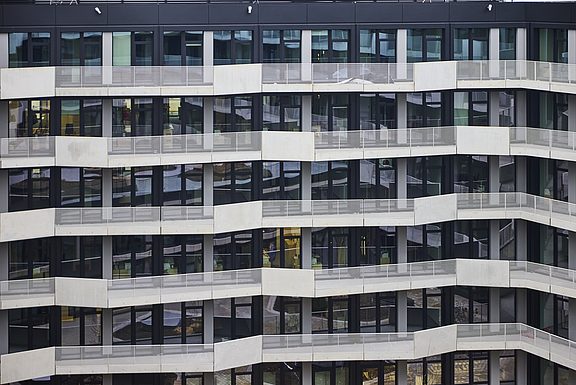
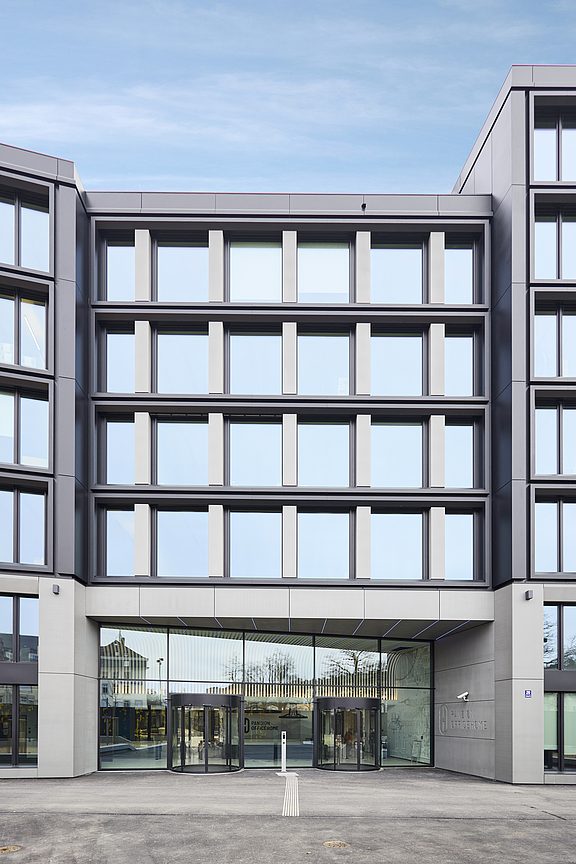
The Werksviertel district behind Munich's Ostbahnhof station is one of the largest and most important urban development projects in the Bavarian capital. A colorful and lively neighborhood comprising offices, commercial premises, and residential buildings is being created on the inner-city conversion sites. Together with the PANDION OFFICEHOME Beat, also designed by Holger Meyer, the PANDA (formerly PANDION OFFICEHOME Soul) forms the southern entrance to the new trendy district on Anzinger Straße. The ensemble consists of two six-story polygonal twin buildings with inner courtyards, which are crossed diagonally by a wide promenade. It opens up the neighborhood behind it. A seventh full story added to the "soul" emphasizes the entrance. From the city, it presents itself as a clearly horizontally structured building. A surrounding two-story base with light-colored glass fiber concrete cladding frames the ground floor area. The staccato of the vertical two-story window incisions is interrupted by the large openings of the four entrances. Above the base are four office floors with a dark element facade consisting of horizontal aluminum frames arranged in a staggered pattern on each floor, each combining two window fields.
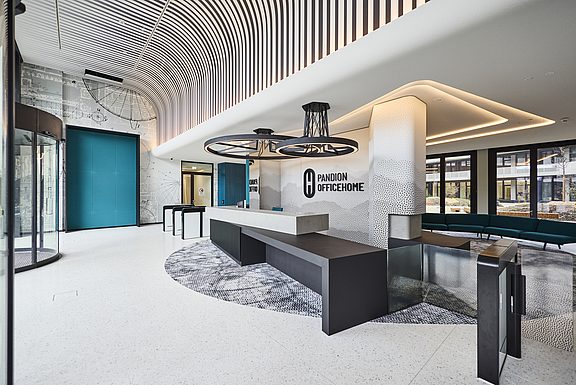
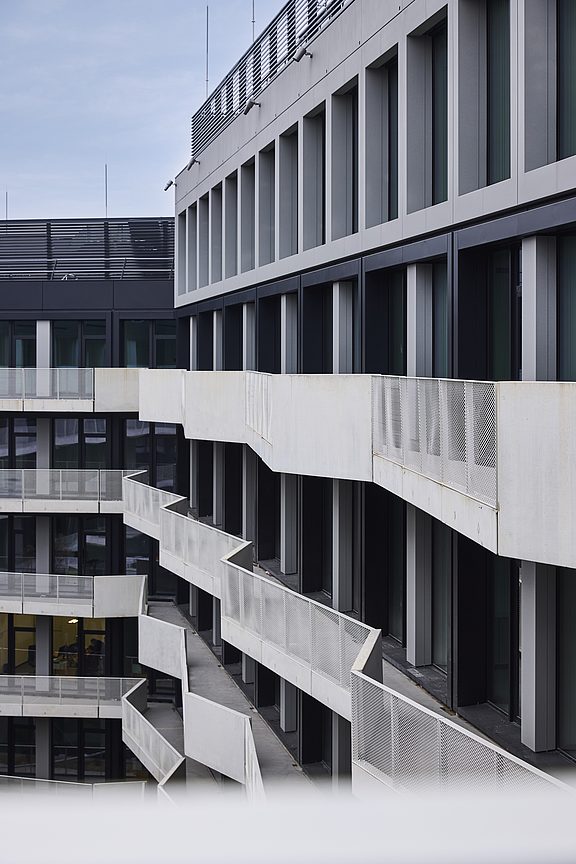
The interior of the block is divided into three courtyards by a transverse six-story wing and a two-story central building to the north. The facade in the courtyards is enlivened by wraparound balconies on the upper floors. Together with the roof terrace on the two-story central building, they extend the office space into the outdoor area. The large southern courtyard is intensively landscaped. A lobby extending through the building forms the representative address on Anzinger Strasse. To the north, the complex is connected to the Werkviertel district by the new neighborhood square on Ludwig-Jung-Strasse. Two additional entrances on the sides allow decentralized access to the block.
Thanks to its flexible layout, the new 45,000 m² office building creates a modern office and working environment for the approximately 1,500 employees of the DPMA. The nearly floor-to-ceiling windows in the offices provide plenty of daylight and create a spacious impression with spectacular views. In addition to the approximately 40,000 m² of office space, a nursery and a staff restaurant are also planned. A library, a sports room, a data center, and storage areas are planned for the second basement level.
The modern mobility concept provides for 400 parking spaces for bicycles with adjoining changing rooms and showers in the underground car park. There will also be 300 parking spaces for cars. Thanks to its location near Munich's Ostbahnhof station, the building has excellent public transport connections. The new building is intended to be certified according to the DGNB Gold Standard.