In this issue, StockWerk deals with the topics of city and country. Is it about contrasts and boundaries or hybridity? What can built cultural landscapes learn from natural ones?
Martin Rein-Cano (MRC): It is a fundamental question of what kind of flow you want to move in. Some people like clearly defined areas. They pack their lives into little boxes and move from one to the next without them touching. This has advantages, but the disadvantage is that connections are thwarted. My longing is for flow, not separation. When I work, I want sensory experiences. When I'm in my free time, I want intellectual experiences. I consider separating experiences to be a 20th-century concept. The divisions of modernity are still present today. One can view this dialectically and claim that separation is necessary so that monotony does not swallow us up. Hasn't it already done so? I believe in mixture and hybridity and that it should not be permissible to create non-sensual places. Places that are dedicated to a single use. Separation is just fantasy. Everything that has grown goes hand in hand with human activity. The untouched, the landscape that arose on its own, no longer exists. Nevertheless, we feel a fascination for something that has had time to mature. Of course, there is magic in every beginning, but with a building, the new is more interesting than the landscape as it grows. In architecture, we should strengthen our longing for growth. It is time for architecture to learn from landscape.
Holger Meyer (HM): It's about hybridity and social change. During the Industrial Revolution, people moved to the city because that's where the work was. That was when mass housing construction began, with the highest possible density. They came from rural areas and found themselves in a sea of concrete. Today, these concrete jungles are neighborhoods that are considered particularly urban and livable.
MRC: Back then, that wasn't perceived as a positive quality. On the one hand, five times as many people lived in the apartments. On the other hand, the streets from the Wilhelminian era, which we now experience as tree-lined streets, had almost no greenery. And the essential thing was that they had the chance to become. Today, we want to shorten these processes. We want to anticipate maturation.
HM: We want to have the urban result at the beginning. Urbanity does not exist on paper. But we can preprogram it.
MRC: Hybridity plays a major role here. We need to write accidents into the program much more. This is not an appeal to us architects, but an appeal to the programmers of architecture. Our programs must be more mixed and hybrid. The more complex a building is, the more complex its ownership structures are, the more its preservation is preprogrammed. Programming begins with ownership. Cities could control land allocation based on size. The Gründerzeit city had a small-scale structure. Small-scale structures give rise to hybridity, which is both more sustainable and more appropriate to social change. Hybridity because it preprograms sensuality, because it allows for the unexpected. Controlled, monofunctional spaces prevent the unexpected. Hybridity is what defines urbanity. It is the unforeseen and an essential part of our human existence.
HM: Lifestyles are changing, and only when pressure reaches its peak does anything happen in our industry.
MRC: This makes it all the more important to address sensuality in our industry. Quality always has to do with sensory experience and should be a fundamental right. What does it mean for our buildings? What does it mean for neighborhoods and cities? What does it mean for public spaces? This quality is not discussed enough, but it is the real quality of life.
You mentioned change. In this sense, digitalization, redensification, and most recently the pandemic have made public spaces more important. New challenges such as climate neutrality and adaptation place demands on politicians and individuals alike, calling for ecology rather than economics. Is it more about ecological or social relevance?
MRC: We shouldn't reduce this to open spaces. The question arises in our entire lives – through our consumption and through architecture. Doesn't the separation of nature and humans already stem from the expulsion from paradise? The fact that we supposedly are not nature has led us to destroy nature over long periods of time. In the same vein, we now have the impression that we need to protect nature. These patterns of thinking need a paradigm shift towards the idea that there is no difference between us and nature. Everything we do is nature. When we protect nature, we protect ourselves and the resources we need to survive. This is primarily an economic issue. But we must answer it holistically. How do I experience sustainability? If a room has a good climate, then a building will also last longer. The same applies to open space. The social question cannot be separated from the question of sustainability. I have focused my work on the social aspect, not as an antithesis to sustainability, but as part of it.
HM: In the environment in which we operate, the only discussion that takes place is about ecology and sustainability. We have to do something, and we are already doing a lot—albeit with a limited national perspective on a global problem. The social component is not being seriously addressed.
MRC: That is where the failure lies. What good does it do us to build a sustainable building today that will be outdated and replaced in 30 years? That is the social discussion: how do we create buildings that gain social acceptance and affection, and that it would even be obscene to throw away?
HM: This applies to the built city as well as to open spaces. Both are about social use and sustainability in the sense of durability.
MRC: We are stuck in a kind of permanent correction loop, in a frenzy of new construction and renovation, which means that although we are building more sustainably today, everything will have to be rebuilt in 30 years. That's good for our profession. As entrepreneurs, we are happy to receive orders. But for sustainability, it is a huge problem that places are not given the chance to grow. Can't capitalism create growth in a different way than through the constant destruction of places in constant consumption? Consumerism takes place in architecture as well, but there is no social discussion about it.
Don't you think that change will give it more momentum? Public space has always been the space of the people. Don't you think that the pandemic has brought it more into the discussion in terms of free space? Isn't the time of "no entry" signs over, and won't the future be about usability and community function? About free interpretation and appropriation instead of determinism? Can't the discourse move on to architecture?
HM: Awareness and willingness to fight for public space have grown stronger. On the one hand, I am a clear advocate of the densified city. On the other hand, we have to fight for public space. And at the same time, living in the city must not become a privilege. If I don't want the city to become completely sprawling at the edges, I have to argue for it to become denser. That's why a residential high-rise is not taboo. Nor is it taboo to consider turning four-story buildings in neighborhoods into seven-story buildings in the future.
MRC: Density like that of the Gründerzeit city is good. It creates shorter distances. Whether the high-rise typology is sustainable is another discussion. But density is essential for encounters and social interaction between different actors.
HM: In Berlin, you experimented with density early on.
MRC: That doesn't bother anyone, because Berlin has always been a city of large public spaces. These spaces take on a different quality when you don't just have residual and intermediate spaces everywhere. Reinforced by the pandemic, public space exemplifies something that I would also like to see in buildings: the desire for self-appropriation and self-determination. A desire that open space has partially fulfilled because it is common property. I realize that it has to take place within a capitalist framework. I am not a fantasist or a social romantic. But it's about a different kind of business model in the sense of a new, socially constructive ethic. That means questioning the clarity of the nomination of space. The purity of typologies no longer exists. Modernism wanted to separate. There were reasons for this, but for cities it was a disaster. In the future, we must build more densely and more diversely. We must act with stricter laws, especially with regard to property. The guidelines must come from politics and society must implement them.
HM: I have long been a critical observer of how inactive the state and politicians are and how much they shift the responsibility onto developers and builders. In the 1950s and 1960s, the whole country was rebuilt and so much living space was created. The companies are still there. It would be easy to define a political mandate through land ownership. It would be easy to say that we are relaunching the programs and deliberately promoting the social and green city. Instead, the housing associations have been privatized or wound up into companies that are now profit-oriented themselves.
MRC: It would be good to have proper building laws where the state says, look, land is like air, it belongs to everyone. Ownership is subject to conditions. If I want to build a residential high-rise for a certain clientele in the middle of the city, I have to create offers for the community at the same time. No one makes these offers voluntarily. These are requirements that we can set as new standards through social policy discourse, but ultimately they have to come from
politicians. HM: At that point, Corona was a turbo booster in a positive sense. The problems that had been there for some time suddenly became a cumulative problem. That our living space is too small to work from home. That public space, which is supposed to ensure social peace, offers too little quality of life. Suddenly, companies, cities, and housing developers have to react.
MRC: It's not about having bigger apartments now, which would seal off even more space and which no one can afford, but about offering more to the community.
HM: In fact, this is putting pressure on the outskirts of cities. There are people who need bigger apartments but can't afford them in the city and are moving back to the suburbs. An incredible upheaval is taking place there.

MRC: Politics still has the greatest influence. As architects, we can discuss these issues and offer suggestions based on our expertise. But the question is how to reconcile laws and interest groups more honestly. It's not easy, but politics has to answer that question. Let's move on to specific questions about Topotek 1. You have been internationally renowned for years and can look back on a huge range of projects—small and large—and a wide variety of tasks.
What distinguishes the projects, what unites them? Are there any favorite tasks or a task that you've always wanted to do?
MRC: I would like to design a cemetery. I like adventure and I am a very social person, which is why Holger and I work so well together. I like social interaction with those who can and want to engage in it. That motivates me. I enjoy collaboration—both internally and externally. I'm interested in new things. I never see tasks as a separate issue of landscape architecture or architecture, but as a social task, a sustainability task. A task for society, also in the sense of collaboration. Collaboration always means forming a temporary community. The better this community is, the more trust you build, the more openly you can act, the better the projects are.
This leads me to the question of your approach, which moves between the tension of a place's legibility and the significance of its narrative. On the one hand, you develop from the context in order to give places a new identity.At the same time, your projects exhibit a kind of eclecticism—today we would call it sampling or remixing—recurring elements from other contexts that speak their own language.
And like filmmakers—Kristin Feireiss has called you storytellers—you generate idealized images. How is that compatible?
MRC: For me, there is no separation. We all think in three dimensions. Thinking is three-dimensional. You have to think in a confused way for something new to emerge. Every project always has a craftsmanship momentum, the physics of a place, which we call context. I can't ignore that factually, and yet I am convinced that you have to breathe life into places. For me, this breathing life into places lies in the narrative. It is very powerful imagery against the backdrop of me wanting to see something. I want my stories to be experienced. The visually powerful narrative makes it possible to overcome growth and shorten time. Trees often take thirty years to become so visually powerful. In the meantime, I need other forms of expression. The narrative cannot be separated from the sensual. Overcoming this separation would present an opportunity for architectural discourse, which is so committed to optimizing processes. Undoubtedly, this is easier to achieve in open spaces because economic interests are less prominent. Here, there is much more freedom, which we try to utilize.
You mentioned thinking in three dimensions. Isn't the fourth dimension—time—also relevant when it comes to open space? Time in its various dimensions of past, present, and future? In the present, you talk about movement, speeds of perception, and contemporaneity. When we think about the future, nature involves much more dynamism, growth, and change. The factor of time and the predictability of the uncontrollable are often contradictory for architects and builders. How do you manage to integrate these two aspects?
MRC: This is very important, and there is no difference between architecture and landscape architecture. Houses also grow, houses also develop a patina, houses also undergo changes. They just have a different cyclical nature. Time has to do with sensuality. We are sensual beings because, to a certain extent, we are always dying. Romanticism stood for the symbolization of transience as an aesthetic quality. Things pass away, and it is not healthy to delude ourselves into believing in a world free of transience. After periods of superficial consumption, we are now seeking a deeper sensitivity, a genuine experience. Time is created by movement in the landscape. I can move relatively freely in a park. The question of how I experience space in motion, on the other hand, is often not answered or even asked in houses. Shouldn't movement in space have a much greater influence on buildings? This is a quality that exists in individual examples, but is given too little attention.
HM: This quality existed, but it was reduced to the mandatory fulfillment of function. This applies to developments as well as facades. Where has decoration in the sense of an identity and recognition factor gone? We do many things that are good and work well. But craftsmanship has been lost. Today, we can replace certain things with new technologies, but awareness has been lost, and that has a lot to do with identification with a place and social acceptance of architecture. The individual, the sensual, the haptic experience have been reduced to economic aspects. This probably works in a similar way in open space design.
MRC: Similar, but the pressure of functional accountability is not as strong as in architecture.
HM: You can achieve much more and achieve great quality with a fraction of the budget.
MRC: There are excellent examples from architecture on the subject of quality through craftsmanship and quality through space creation. Scharoun's Philharmonie in Berlin is a good example. Built simply on a low budget, it is one of the spatial wonders of architecture. It's simply a matter of designing good spaces.
Let's return to the subject of materiality. When we think of landscape architecture, we romanticize greenery, naturalness, building with nature. In your projects, natural and artificial materials often meet in combination with strong colors and graphics. What significance do these have for your work?
MRC: Landscape architecture has a long graphic tradition. Think of the design of the Capitol in Rome, mosaics or paintings in southern England (Dorset Giant). Drawing on the ground has always been there. Let's consider another aspect: in English landscape art, we talk about the picturesque. The image of the landscape existed before the landscape itself. It was paintings by Nicolas Poussin and Claude Lorrain that led to English landscape gardens. The connection between landscape architecture, graphics, painting, and art is nothing new. We, too, have experienced a kind of functionalization over the course of the 20th century. Landscape architecture could no longer justify itself purely on the basis of its visual appeal. It had to become a necessity. We need open spaces, but a roof over our heads is more necessary than a park. In this process of functionalization, the artistic tradition that constitutes the very essence of landscape architecture has been lost.
HM: What I particularly like about your work is the element of surprise and the contrasts. There isn't just one solution. Sometimes it's green, sometimes colorful, then you work with very strong symbolism again.
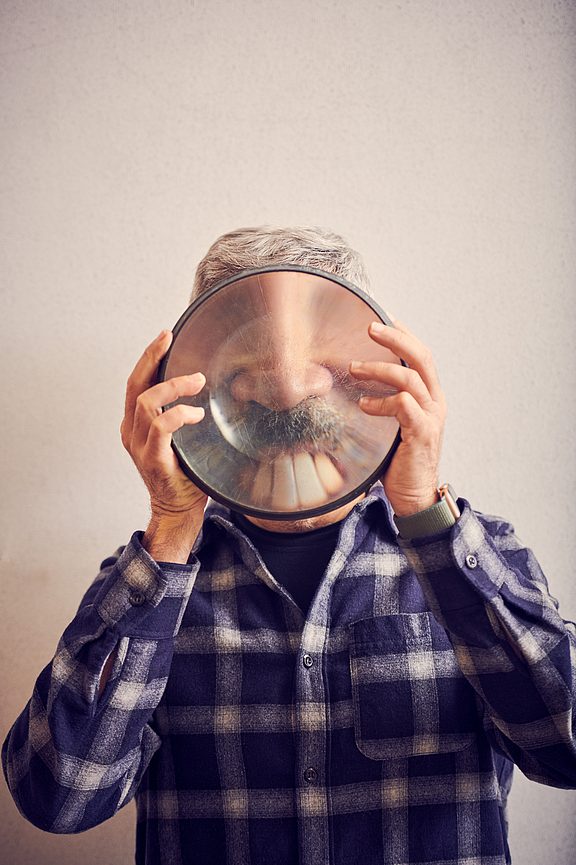
MRC: I am a child of the 80s and therefore of postmodernism. I like eclecticism, but what I enjoy most is trying out new things.
HM: That's something we both have in common. We never give the same answer to a similar question. We have different locations and different clients. Our architecture, our landscapes, and our open spaces respond to that.
MRC: It's the nonchalance with which we deal with places—also in terms of the spirit of the times. Let's move on to the topic of collaboration. You have worked with big names, small offices, and often with artists. What is important in interdisciplinary collaboration? Is it about the technical or the human, such as a similar attitude, a similar understanding of humor,
irony, provocation, and the joy of experimentation that speaks from your work?
MRC: It's the human aspect. Even though Holger and we came from different worlds, the interaction was open from the start. We are both non-ideological in an ideological way. Our collaboration is characterized by openness and allowing developments to happen.
HM: Martin's great quality is that he is uncomfortable, always questioning things critically. I also seek this discourse in the office, and ideally it also arises with clients. The best builders are those who are open, who explain why
they want something and why they don't want something. The more productive and open the process, the faster you achieve quality.
MRC: It's about flexibility in thinking and adaptability. It's about open collaboration, which can sometimes be a little painful.
Working in networks is the topic of the future. Unfortunately, this has hardly found its way into teaching and practice.
MRC: I find that this is almost never the case in Scandinavia. Scandinavians are very willing to communicate. Even the big names continue to develop their projects in communication. That was also a learning process for me. Today, I have to say that I work best with good partners. Our best projects are those we have done in collaboration.
HM: Communication, openness, and interdisciplinary collaboration are generational issues. The other model is outdated; it no longer fits in this world, no longer suits the tasks at hand, and no longer matches the pace. Today, developments must be discussed in a different way. We need to listen to many more people. We talked about professional and human cooperation. We talked about public space as a space for society and its social relevance in terms of a culture of togetherness. How important is cooperation with society?
MRC: We need to listen more. But we need to differentiate between different forms of participation. The question of participation requires different answers in different places and for different tasks. Allowing thinking means allowing mistakes. That requires a culture of error that we have to learn.
HM: It's about the tension between more democracy and necessary dictatorship. A planning process never comes to an end unless someone says, "Let's do it now." We talk too much about things. We don't take action.
MRC: That has to do with the culture of discourse. We don't discuss the essential issues. We need to control and qualify the discourse. We are so negative about the future, and talking things to death is a typical example.
HM: One thing is talking things to death, another is refusing to take responsibility.
MRC: Irresponsibility is a symptom of the constant availability of everything, not the cause. It's about more qualified democratization in discourse.
HM: It has to be results-oriented. The worst thing is not to have a result. Listen more and do more than talk everything to death. I think
that's a nice joint result. Thank you very much for this discourse.