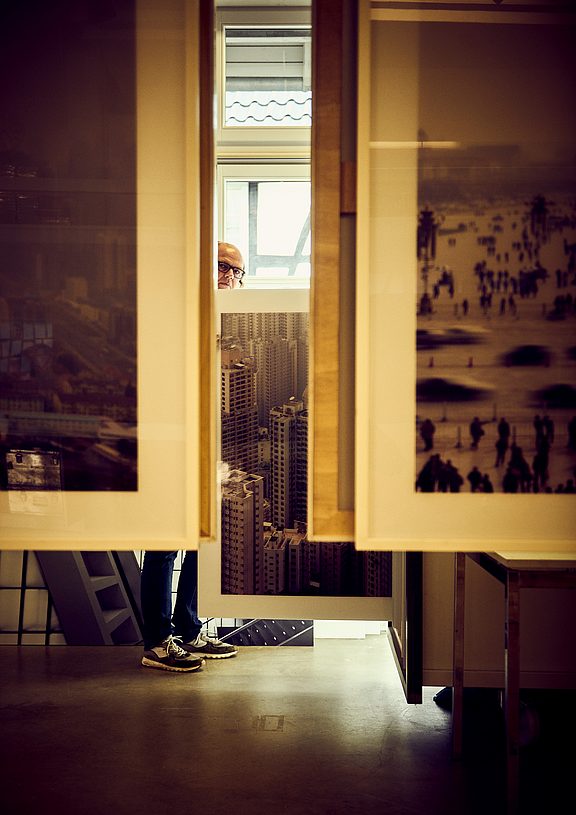
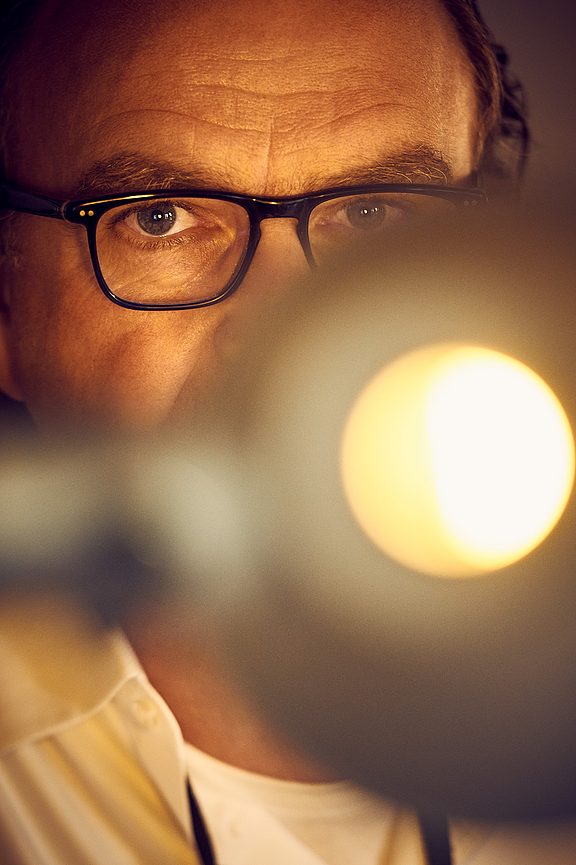
Photographer Hans Georg Esch became known far beyond the architecture scene with his large-format photographs of the skylines of the world's megacities. Born in Neuwied in 1964, Esch lives and works in Blankenberg in the Siegerland region. In addition to architectural, product, and art photography, his studio also offers book and video productions with a focus on architecture. In collaboration with leading global manufacturers such as Leica and Samsung, Esch develops new technical products to make his elaborate productions even more immersive.
On the A3 towards Cologne, take the Siebengebirge exit. The highway gives way to a varied landscape. Narrow roads wind their way through forests, fields, and villages. We are on our way to HGEsch, one of Germany's best-known architectural photographers. His large-format cityscapes have made him famous worldwide. We meet the photographer far from any urban environment in his studio in Blankenberg in the Siegerland region.
You travel a lot and work in the world's major cities, but you live here in the countryside. Was that a conscious decision?
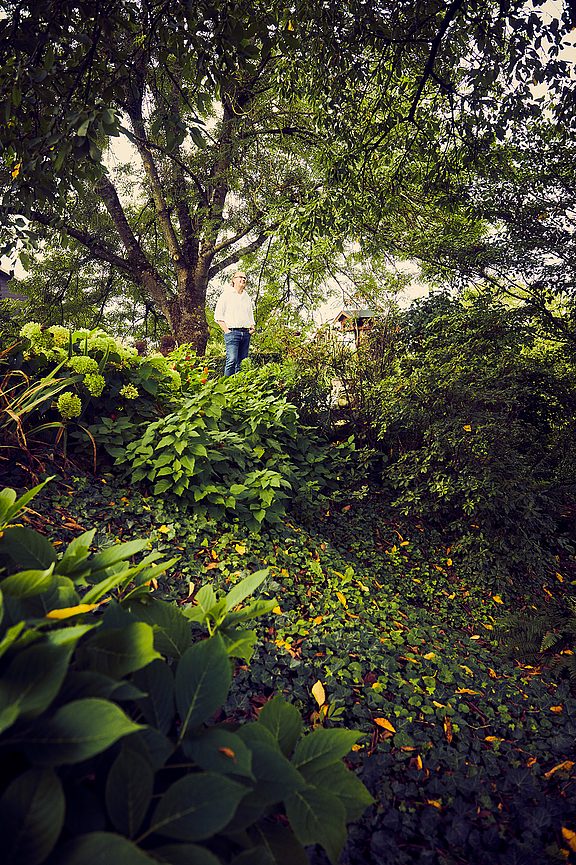
HG Esch (HGE): I like being here in my studio in the countryside. For me, city and country are two areas that I don't want to separate. There is good architecture in the city and in the countryside. And both are a challenge. I approach every job with the same intention, the same heart and soul, and the same passion. And after assignments in Shanghai, Tokyo, or Rio, I enjoy the seclusion of my studio—just looking out at the greenery, resting my eyes, and cycling through nature. Which brings us to the topic at hand: in your large cityscapes, people take a back seat to the composition. The human connection is missing.
HGE: I don't think so. Architectural space always relates to people as a measure. Whether I see that in the pictures or not is secondary to me. On the contrary, I don't like it when people are placed in pictures just to create a human connection. I think it's much more important to look back after a while and see how people have responded to the building, how they interact with the architecture, whether they feel comfortable there, and how they live or work there. I always advise my clients to revisit their buildings with some distance. We've just published the book Restlicht, which tells just such a story: the former Osram headquarters in Munich by Walter Henn. Ten years ago, Gunther Henn asked me to photograph the building again. Heidersberger, the photographer of post-war modernism, had photographed the building in black and white in the 1960s, and it still had the same charm. It was then used as a refugee home after Osram moved out. I captured that in my photos too: 800 refugees lived in what were once Germany's first open-plan offices. Then it was listed as a historic building, but was demolished anyway. I photographed that too. I find it very exciting to be able to accompany a building as a photographer. The buildings disappear and only the photos remain. So, after pressing the shutter, you've made a piece of history.
In the book, Heidersberger's black-and-white photographs are juxtaposed with your color photographs—which do you prefer?
HGE: Both. There are motifs that are more beautiful in black and white than in color. You photograph differently in black and white because the rooms are characterized by much more contrast and shadow effects, and of course you have to know whether you're going to show it in black and white or in color afterwards. The idea comes to me while I'm taking the photos.
Do you still take analog pictures sometimes?
HGE: No. Analog is no longer an issue in commercial photography. Digital technology offers so many advantages. I was one of the first architectural photographers to use digital techniques. It all started in 2001 with a calendar project. We photographed digitally and analogously in parallel, but in the end only one digital motif was selected; all other images used were based on analog technology. My fee was a digital back. It sat in my closet for two years until a client needed pictures of a house in Dubai within two days. That was only possible digitally. After that job, I was convinced of the digital way of working and its possibilities, and three months later I got rid of all my analog equipment.
Holger Meyer (HM): Do the images first form in your head?
HGE: Yes, I first work out each image in my head and then I implement it with the camera. Before I start taking pictures, I look at everything closely and let myself be inspired. For me, the building is the staging itself, which I only photograph. I try to capture the building from a wide variety of angles so that it is presented comprehensively. Thanks to technology, you can see the results immediately today. But there are always moments that you cannot foresee.
HM: In your work, you place the objects in the context of the city and public space in order to dissolve the abstraction of the object and show it in an overall context. In order to assess how the object appears in its immediate surroundings, we architects have to show our houses in context. That's what we appreciate so much about your work. It creates an atmospheric density—that gives your pictures something very special.
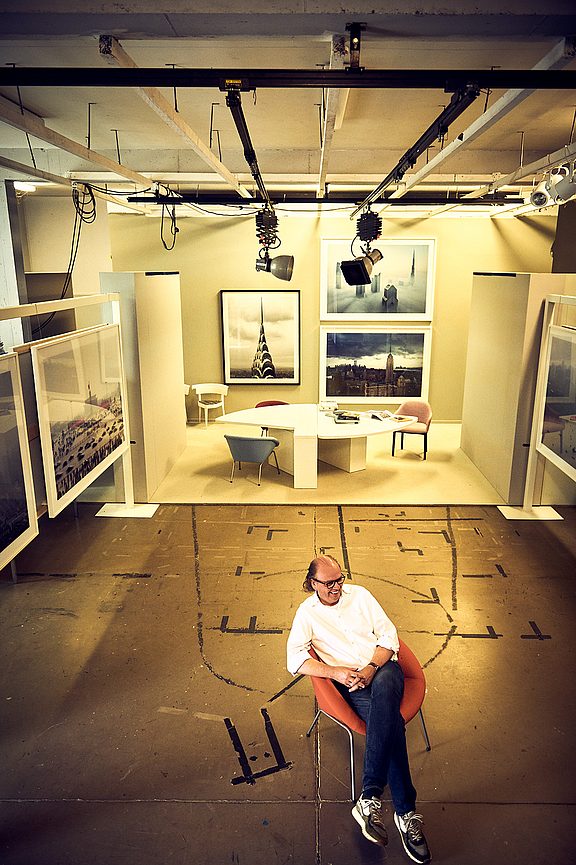
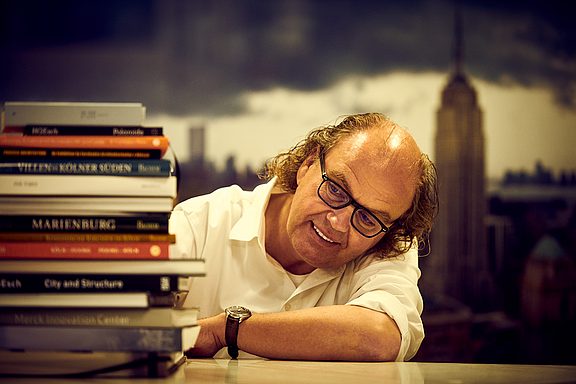
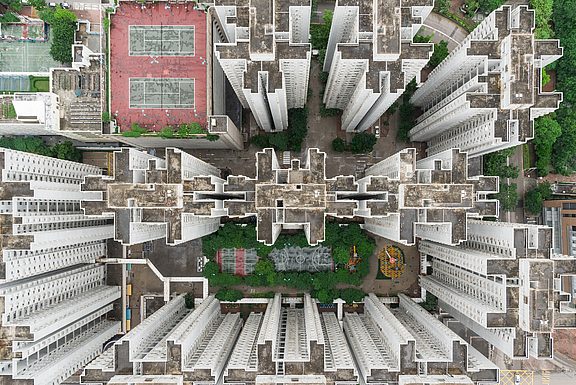
HGE: Moving away from purely documenting individual buildings and toward the big picture is currently a trend in architectural photography. I was one of the first to create large cityscapes. A building has an impact on its own in the urban space, but capturing that impact photographically is the challenge. And through this contextual representation, the viewer gains an extreme appreciation for the building.
HM: I am also fascinated by the degree of abstraction in your photos. We architects try to digitally anticipate reality with our visualizations. We create images in which the layman may no longer be able to tell the difference from reality. When the building is then completed, HGEsch comes along and turns the built reality back into an abstraction. We love this level of abstraction in your photos because something abstract emerges from the built environment. We actually try to generate precisely this mood and abstraction in our visualizations, but then we only find it again in your pictures.
HGE: The house stands and reacts in an urban or landscape context, which you can only depict photographically. This is not possible in rendering. It is the search for reality, for proof. The depiction of reality is very important to me. We are currently working on a book about our commissioned works. It also includes a theoretical section by Peter Cachola Schmal. He assumes that renderings will replace photography. I don't see it that way.
HM: I'm always surprised by how different your images of the built object are. Take St. Martin Tower, for example. I spent a lot of time studying the forecourt, but I never saw the drama of the soaring building the way you captured it.
HGE: Yes, it's always the surprising photos that stick in your mind and are then usually published. But first you have to find them and work them out in your mind. I'm not approachable when I'm working, and my clients let me work freely. No one tells me in advance where to stand.
HM: But are there still things where you stand in front of them and say, "That doesn't do anything for me right now"?
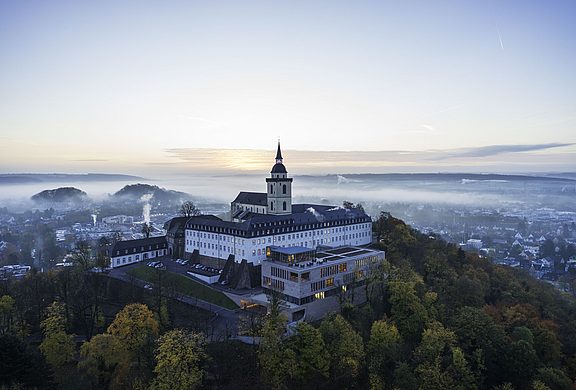
HGE: Photography is my passion. Even mundane architecture can have interesting aspects. Working that out is always a challenge for me. That's why there's hardly anything I say no to. If necessary, you go there more often to take a closer look. I always tease out the last bit until it's right for me and for the client. The weather is usually the biggest uncertainty, but also the biggest source of inspiration. You can't order a picture like the one of Michaelsberg Abbey with the landscape in the fog. You have to be flexible and stick with it until the end.
Do you still take all the photos yourself?
HGE: I still take most of the photos myself. I'm on the road 200 days a year, standing behind the camera myself. But I now employ 17 people here. That brings in different perspectives and broadens our spectrum, but it also requires a lot of organization. However, the photographers who work for me are so well trained in their perception and visual language that I can put my name to their work one hundred percent.
HM: We architects also work in teams, and the creative exchange in the process is always inspiring. But you also have to take creative leadership. I see this in the tradition of the old masters, where you went to Rubens' workshop to learn and copy. Rubens didn't paint his works alone, and yet they are all Rubens. It's a good tradition to develop creativity from within the team.
HGE: Yes, and you also develop yourself further with the team. As a photographer, you actually help shape the branding—the brand—of the offices, because in the end, the photos always go out as a reference.
HGE: Very few people see the building in person; they only see the pictures. Ingenhoven always says, "Hans Georg, you convey our architecture." And so you develop a unique visual language for each client. I photograph differently for Henn than I do for Ingenhoven, KPF, or Holger Meyer, because the architecture is always different. But that's exactly what makes it special, engaging with the client and developing together with them.
Recently, an architect said to me, "In your pictures, I always discover so many new and beautiful things that I can then incorporate into my work. But also things that we could have done better."
And even now, in the age of COVID-19, I've had a very nice experience. Last year, we rented a small chapel in Cologne for an exhibition of my work. Because of the pandemic, each visitor had the exhibition to themselves, and we were fully booked every day for a year. Some people stayed for several hours, taking the time to engage with my photographs. And that's what I find so wonderful about my job, that I can take people with me on my travels.
Thank you very much for these insights.