
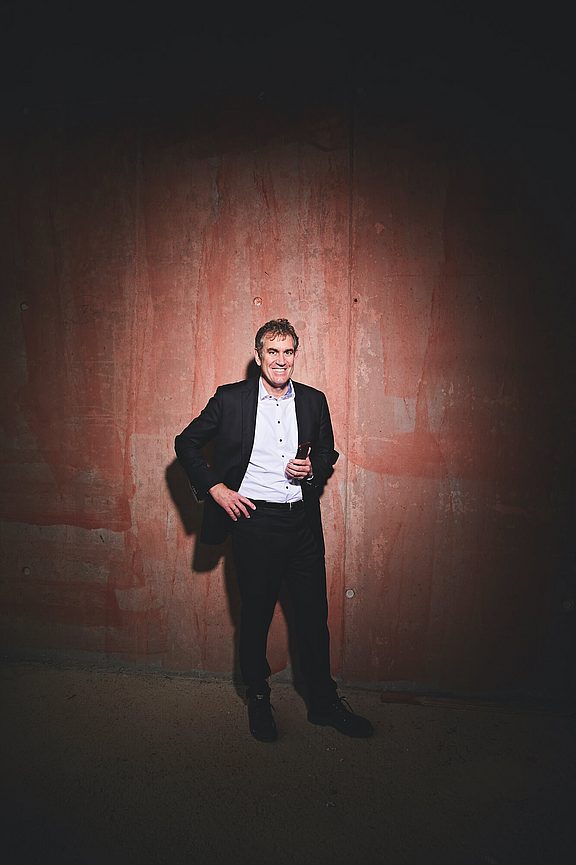
Stock Werk: We think the idea with the beer coasters is great. Did you ever imagine that your photos would one day be printed on beer coasters?
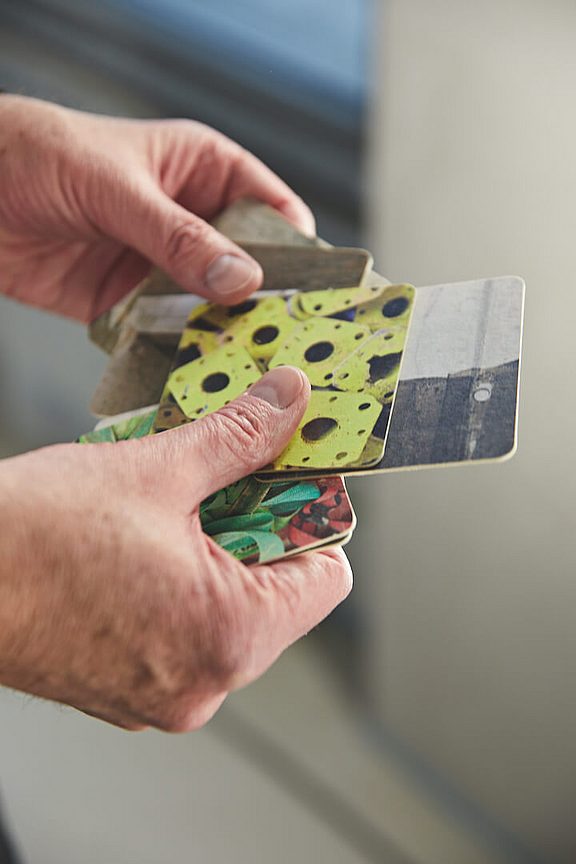
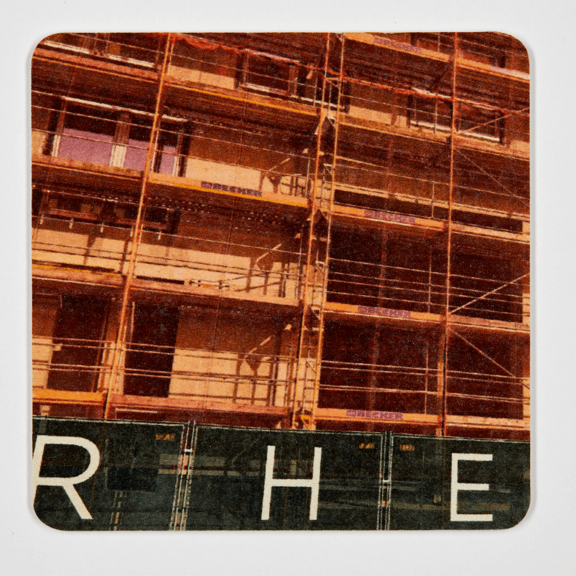
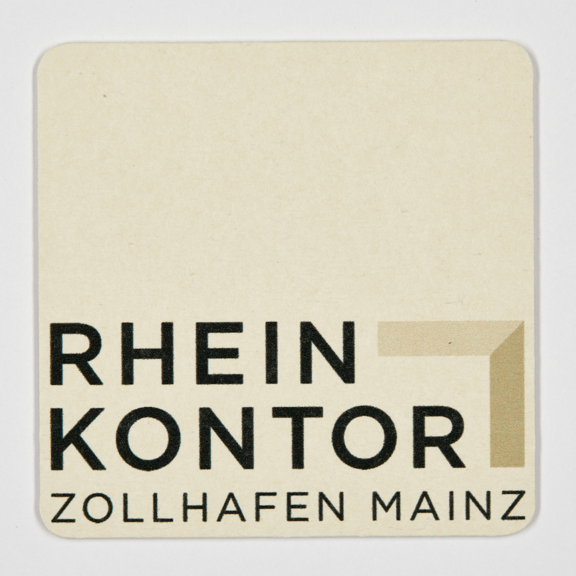
Dirk Neugebauer (DN): (laughs) No, it was a big surprise for me too. The project team gave them to me as a gift at the topping-out ceremony for the Rheinkontor building.
Will the beer coasters also be used here in the restaurant, or do you only have them at home in the bar?
DN: Of course I have some in my bar (laughs), but it would be nice if we also had them as standard equipment in the staff restaurant.
Was this the first time your pictures were presented in this way, or does it happen regularly?
DN: It was the first time. We deliberately organized the topping-out ceremony for the Rheinkontor in Mainz's customs port in a completely different way: culinary, musical, and photographic art were presented. To my surprise, the pictures I had taken here during the construction period were suddenly hanging in large format on the scaffolding, and these beer coasters were laid out. They were very well received. As soon as the topping-out ceremony was over, the site management placed or hung these large-format, mounted pictures from the scaffolding in our site office.
The large pictures could now be hung nicely in the lobby downstairs.
DN: Yes, indeed. But here at the Rheinkontor, we will tell a different story: the thousand-year history of this place. When we started excavating the construction pit, we came across well-preserved Roman amphorae. The find was a huge surprise for everyone. Even the state archaeology department did not suspect a settlement on this side of the Rhine. The amphorae were almost intact, so you could still read what used to be in them: fish sauce, wine, and the like. They came from Italy and were once shipped around Gibraltar to the mouth of the Rhine and then upriver. After they were emptied, these amphorae were placed under the buildings here to break the capillarity against the rising groundwater. It was an intelligent construction technique for its time and perfect recycling. The amphorae are currently still with the restorer, but as soon as they are ready, they will be put on public display in the outdoor area. Everyone is welcome to visit.
Holger Meyer (HM): Actually THE horror scenario for every project developer!
Did this cause a long delay in construction?
DN: No, the archaeology was integrated into the construction process, as this was not a suspected archaeological site. We always excavated areas where no finds had been made or where they had already been recovered. Everything was photographed, measured, and mapped beforehand. Unique bronze artworks and everyday objects such as old wooden spoons were even found. This prompted us to display these fine little items in the dining room of the LBBW staff restaurant. After all, they belong here. This is the history of the place, and the Rheinkontor will also be integrated into the historical trail through the city of Mainz.

Have you always photographed your projects like this?
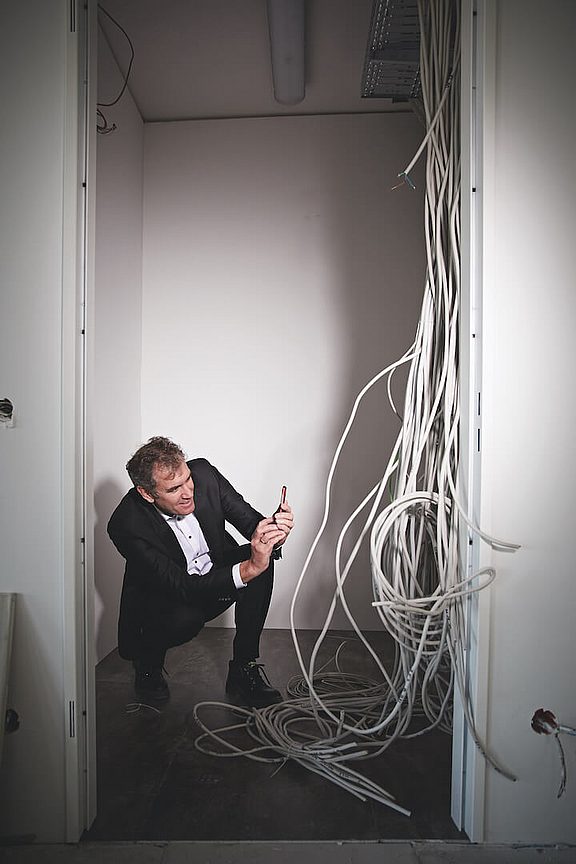
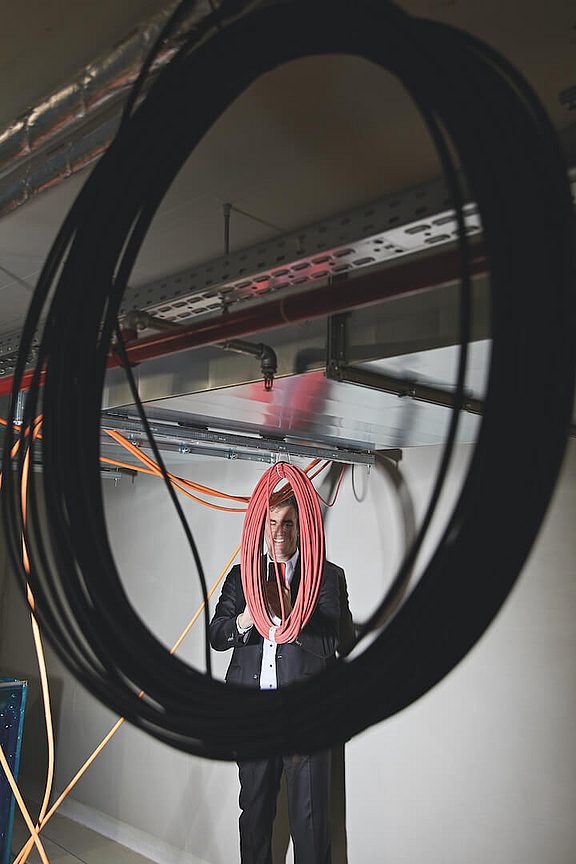
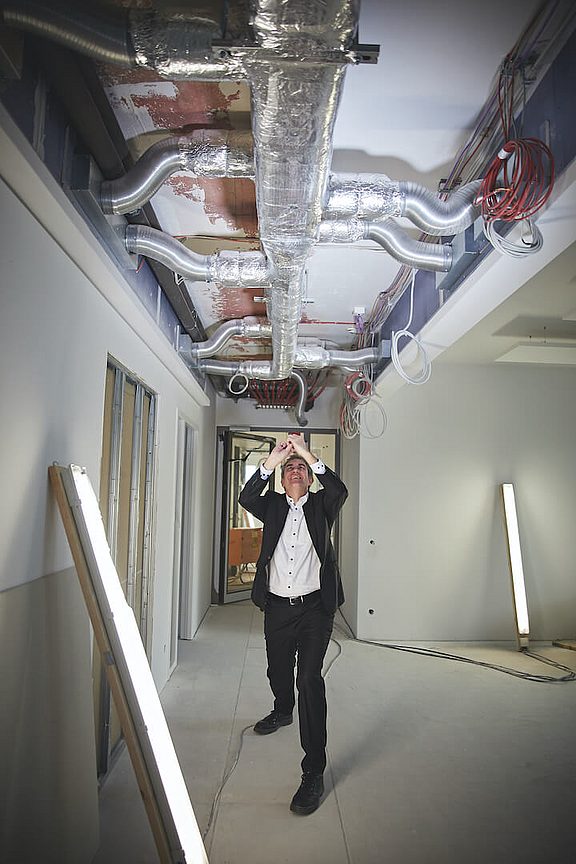
DN: No, I only started doing that during the project work. I only do it for projects that are really close to my heart. I believe that I am actually a failed artist. I never intended to become a civil engineer, but rather an architect like my brother. Or a photographer. I love photography. At some point, I noticed that there are many small details on construction sites that get lost in everyday operations or are not seen at all. So I started taking a walk around the construction site every now and then when working on exciting projects. If I want to get an impression of how the construction site is progressing, in addition to visiting the site and assessing the construction status, I go there on my own. Ideally in good light, i.e., in the morning or evening.
HM: Do you always have your camera with you in the car?
DN: My cell phone. Nowadays, they take great pictures and have good resolution, as you can see. During my tours of the construction site, I always notice little details: beautiful geometric shapes, plays of color, everyday objects that suddenly look completely different when viewed through the chosen frame. For example, these tension straps here. Sometimes you have to arrange things a little bit to get a nice composition. If you then crop it to a different format, it's just abstract art.
HM: For me, it's a completely different view of something transient. This roughness is then lost later on when the work is completed.
DN: They become picture puzzles where you have to think about what it is. And then you quickly realize that they are mostly very mundane things. They catch my eye when I walk across a construction site and take pictures. It's more difficult to photograph an office space, for example. The mountains of cables in the IT distribution rooms or the shimmering metal ventilation ducts under the ceiling that hasn't been suspended yet are rewarding subjects. Carpets and white walls are less so, because color often plays only a minor role there.
As developers, we usually only design the facade and the common areas together with the architects. This is where we set the accents that make the overall concept of a building, its quality, and its relationship to its location understandable. Behind the rental area access door, however, our joint design freedom is often limited... unfortunately.
If you had become an architect, who would have been your role model?
DN: Tadao Ando. (laughs) That's probably because I trained as a reinforced concrete builder before I started studying civil engineering.
HM: Those are really different worlds. Concrete builder, civil engineer, and artist.
DN: Yes, exactly. In the past, it was playing cards and calculators, and today it's Excel-driven project development. (laughs)
HM: That's how you get to know people you've known for a long time in a whole new way. On the surface, you're a very pragmatic person who is responsible for the success of the project on the client side. But when you take a second look, you see a keen eye for detail and a sensitivity for design. That changes the perspective when working together. You have a different level of discussion when it comes to design. When we discuss a facade in the future, I know that behind the pragmatic and commercial approach there is someone with whom I can discuss what brings depth and quality. Because there is someone who understands light and shadow and not just numbers. I believe that the best projects can emerge from this kind of collaboration, where you meet on equal terms in terms of design standards.
How did the collaboration with Rheinkontor come about?
DN: Through the competition. We always enjoy doing that, because it generates good ideas for the location and for what can be done with the framework conditions of the development plan. The results here were very different.
We originally started here in the former customs port of Mainz with the desire for robust architecture. Six firms were invited to participate in the competition. Holger Meyer's design immediately convinced us because we saw that it was good, appealing architecture that also reflected developer perspectives such as development and small-scale rentability. That's not unimportant for this location.
Even though LBBW will be the main tenant here, there is still enough space to rent. I have learned to develop efficient but high-quality projects. As project developers, we sell space, surfaces, and dreams. At the end of the day, that is our business. This requires a lot of optimization, starting with the property and its utilization. Then, together with architects and specialist planners, we look at the spaces: cores, shafts, developments. The spaces are then optimized in terms of layout, rentability, and flexibility. This is followed by the surface, facade, and interior design. This is how we ultimately create dreams – whether for the tenant, the buyer, or the end investor.
Mr. Neugebauer, thank you very much for these insights.