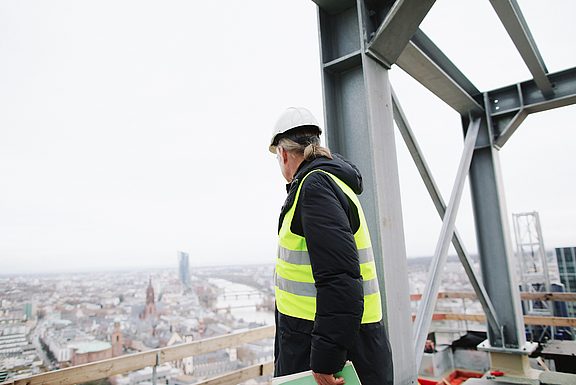
GLOBAL TOWER
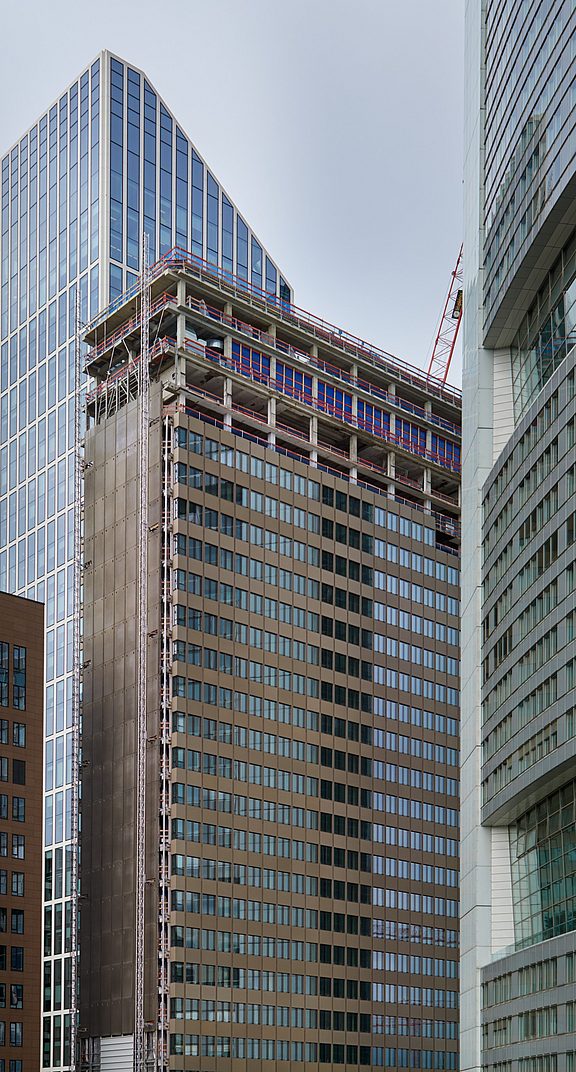
The skyscraper on Neue Mainzer Straße, built in 1973, was designed by Frankfurt architect Richard Heil, who won an invited competition between seven firms in 1968. Commerzbank used the building as its headquarters until 1997, before moving to the new Commerzbank Tower designed by Norman Foster. The building was then leased to the ECB and, after the ECB moved out in 2016, sold to GEG, which is repositioning the skyscraper on the Frankfurt office market as the Global Tower.
HEINZ WIONSKI
Head of the Department of Building and Art Conservation, Hessian State Office for the Preservation of Historical Monuments, State Conservator at the LfDH, author of various specialist publications. For the Global Tower, holger meyer architektur worked with him and the monument preservation authority to develop a renovation concept for the façade after the high-rise building was listed as a historical monument in 2016.
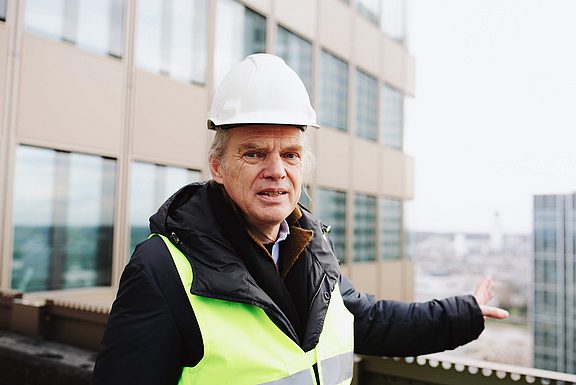
Heinz Wionski (HW): We have been working for some time now to identify exemplary buildings in Frankfurt, particularly high-rise buildings, from the 1960s and 70s that are worthy of protection. Some important high-rise buildings from the post-war years in Frankfurt are already listed as historical monuments. We have begun to broaden the scope of high-rise history in Frankfurt and have also expanded the list of properties. The Global Tower was one of them.
In the competition held in 1968, the design by Frankfurt architect Richard Heil emerged as the winner, reminiscent of the architecture of the International Style and the work of architect Mies van der Rohe. A design solution that is once again very relevant today. The design was special at the time because, due to the staggered arrangement of the office windows, it no longer had four identical office facades, but narrow, closed front sides and a filigree glass curtain wall in front of the offices, which is representative of the architecture of its time. In our view, this makes the building worthy of protection. In addition, the base structure anchors the building perceptibly in the street space.
Inside, so many changes have been made to the structure over the course of its use that we are limiting our protection to the cubature, the facades, and the base structure. We work with five criteria that form the basis of each evaluation. We examine the historical, artistic, urban planning, technical, and scientific aspects of a building or even just parts of it. The Global Tower fulfilled these criteria in terms of architectural design, the composition of its volumes, urban planning with its base, and history, as it dates from a past stage in the city's urban development.
Holger Meyer (HM): We were still investigating on behalf of Commerzbank how the bank could use the building after the ECB's imminent move. In the course of the investigations, the building was listed as a historic monument. For this reason, and based on the results of our investigations, Commerzbank ultimately decided to sell the building. The monument designation followed shortly thereafter.
We had a meeting with the historic preservation office in connection with the preparation of the building application. And it became clear relatively quickly that we would not be able to preserve the façade. It was leaking and also contained asbestos. The building inspectorate pointed out that we had to coordinate this with the responsible contact person at the historic preservation office, Dr. Stefan Timpe. This set in motion the process of listing this building as a typical representative of the late 1960s and early 1970s.
HM: We approached the project as we approach every renovation project. At that point, it was not yet a listed building, so we initially took a critical approach. The task was still very general and dealt with the questions that always arise in a revitalization project, regardless of whether it is listed or not: Is the overall structure suitable for a fundamental revitalization? To do this, the building had to be stripped back to its shell. The entire interior from the 1990s, all the technical systems, and the façade had to be renovated to meet current technical requirements. The concept of the building is based on a very consistent, clear design, as Mr. Wionski already explained. That is one of the reasons why it was listed as a historic building. And this step naturally also changes the process for us architects. Since the discussion resulted in an equally consistent stance, the task was very clear to us: we had to deal with the façade in detail.
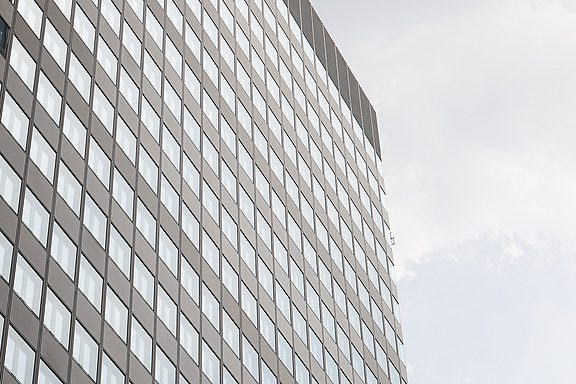
HW: I think this solution, as it is now being implemented, is absolutely successful both in architectural and historical preservation terms. On the one hand, we have the reference to the past, and on the other hand, new technical aspects have been added that preserve the functionality of the building. It's not obvious, but it's noticeable. It's a technical solution that further develops the idea of the design and transposes it into our time. You can understand what has happened—and I think that's very good.
HM: For us, the key question was: How can I translate the filigree nature of the old curtain wall into a technically contemporary solution? The old façade was still the same as when Mies designed it. It was truly a precision piece of steelwork that characterizes the clean lines of the building. It became clear to us relatively quickly that this could no longer be achieved with a normal single-shell facade today. That's why we opted for a double facade: the inner facade layer acts as a climate envelope, which is now standard for technical, functional, and energy reasons. The delicate outer second skin replicates the flatness and framelessness of the original facade. This also gave us technical and creative freedom: the double facade enabled more efficient sound insulation, concealed window ventilation, and offered the possibility of installing external sun protection.
This attitude is somewhat reminiscent of the English approach to monument preservation, as exemplified by the National Filter in London: first, we look at what is worth preserving. What defines a building? Its character, its conceptual design? This is diametrically opposed to the other, conservative approach, which says: everything that is original must be preserved. How do you approach a project like this one? Is International Style architecture your favorite era?
HW: My architectural or artistic preferences take a back seat in my work. Strictly speaking, the approach is always the same: What are we dealing with? What is the subject matter? And the most important question always comes at the beginning of the process: How should the condition of the building be assessed? In the case of the Global Tower, it became clear relatively quickly that the interior had been remodeled several times during its use and adapted to different purposes. It was not possible to preserve or restore the original condition here. So the focus was on the external form, the urban planning situation, and the façade. This quickly led to the formulation of the task: to recreate the structure of the façade elements as we had found them in terms of materiality and quality. Since the original could not be preserved, it became all the more important to preserve the timeless elegance of the façade.

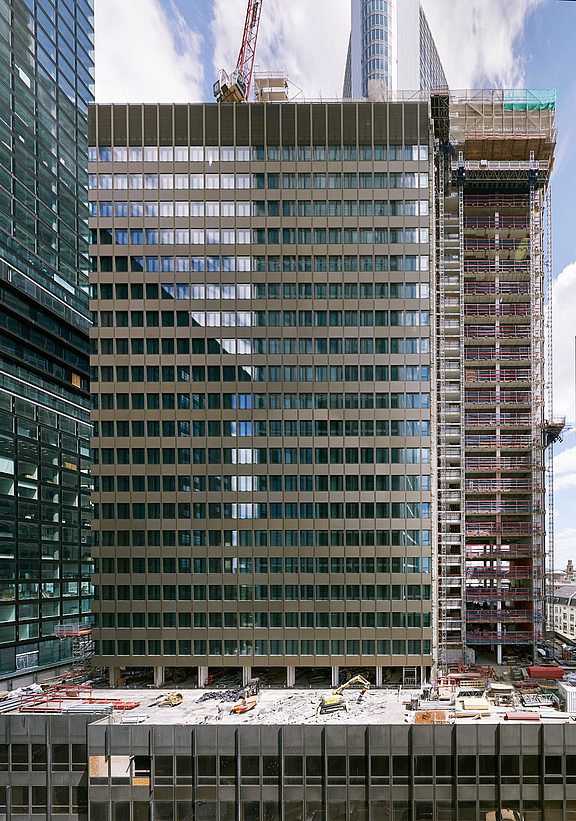
HM: And despite the tight constraints we were working under, we managed to bring out the building's qualities: it had terraces on the roof and on the base floor on the fifth story. Continuous glazing created a visual joint between the base structure and the high-rise shaft, from where you could also access the terrace. Over time, the joint and the roof terrace were closed off by technical installations and fixtures, and what was actually a public floor became a technical area. Now the floor is being reopened and, with a terrace, it is once again being put to practical use. This allows the quality and the original concept to be experienced once more. The project is therefore also a joint success for the historic preservation authorities, architects, and owners. After all, we all want the same thing in the end: for the building to be successfully repositioned on the market, for the space to be leased, and for users to understand the building and its concept. The historic preservation authorities want to preserve these buildings, and we as architects ultimately want to create a successful product for and with our clients.
The approach of preserving a suitable building in its concept and consistency is, as you can see, a successful product: we are able to transfer such buildings into a second, very sustainable cycle of use lasting another 50 years. We do not completely demolish the building; the shell remains standing. We build faster, we preserve built resources, and we can realize at least the same amount of space. We also spoke with the son of architect Richard Heil about the building's heritage status—and thus also about his father's copyrights. The son is also an architect and thinks it is good that his father's work is being preserved and continued.
I believe that renovation in accordance with monument preservation guidelines is also an architect's job. We should not identify solely with our own work. These are also obligations that we have. As an architect, I have no problem identifying with my contribution to the design. Quite the contrary—it makes our work very valuable: we have transferred the building into its next life cycle with a clean design and technical solution.
HM: That's a result of the new urban planning requirements in the development plan. It calls for public zones on the ground floor. We want to give this building back to the city as an urban space that can be experienced. This requires presence and publicity. Here, too, we approached the issue from a variety of angles: Should we open up the corner completely? Should there be more floors? When does the base lose its power as a base? What is the significance of this corner?
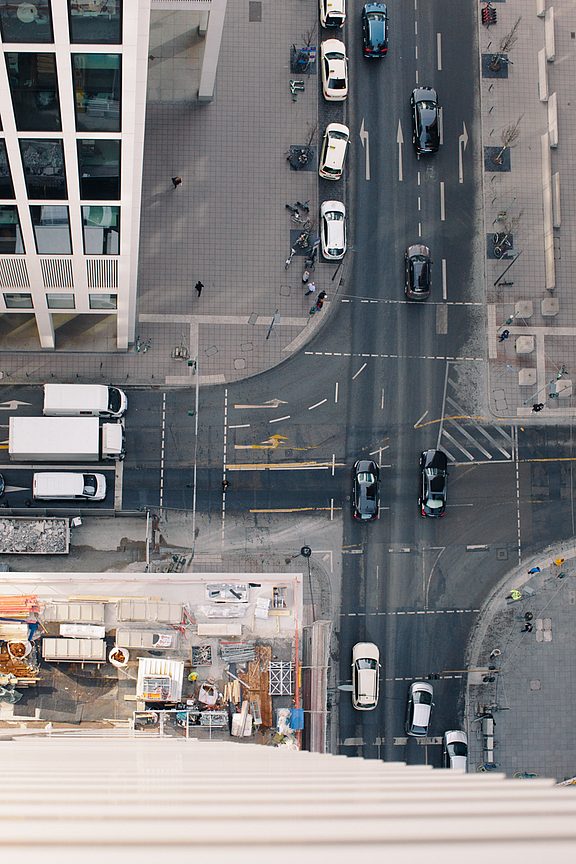
We always have to consider the street space of the entire Neue Mainzer Straße. The Global Tower is located at the only intersection in Frankfurt that has a real New York feeling: each of the four corners is occupied by a high-rise building.
Opposite, the Taunusturm tower has been built, and now the "Frankfurt Four" is coming. A new public square is being created on Große Gallusstraße. In terms of urban development, this is one of the areas that will undergo the most noticeable change in the city center over the next five to ten years. This sets a process in motion and is slowly being reclaimed by the city as a space that can be experienced.
This is where we come full circle, laying the foundation for a successful second life cycle for a building. On the one hand, respecting the substance and sensitively restoring it, and on the other hand, giving the building, but also the location, a whole new second life. It was precisely on this issue that the collaboration with Mr. Wionski was always pragmatic. In our discussions, we worked out solutions step by step. We respect each other, we understand his point of view, and I believe he respects ours as well. And because we both know that, in the end, we are both working toward a convincing result, we come up with really good solutions.
HW: We see ourselves in this process as mediators who have to reconcile the interests of monument preservation with those of the owner. These are two sides of the same coin: on the one hand, our authority has a public mandate to identify cultural assets and to protect and preserve them through appropriate measures. On the other side are the owner and the architect. For the builder, dealing with the issue of historic preservation is initially costly, time-consuming, and sometimes nerve-wracking. The question often arises: How can we best get around this? Our experience shows that when a dialogue develops between the owner, the architect, and us, both the insights and the enthusiasm for the cause grow. And, of course, there are also owners who are passionate about the project and identify with the property and the challenges. This makes it all the easier to communicate during the process and start a dialogue. Construction is very complex, and there are many tasks that the owner and architect must solve together. In our process, however, communication with the architect is easier. Since the architect is more technically skilled, we can get to the point more quickly. As Mr. Meyer rightly said, in the end we both want the same thing. And when things go as well as they have here, it becomes a trademark. And that in turn has an economic impact. A win-win-win situation, so to speak.
HM: If we look at it from the developer's perspective, they recognized the outstanding quality of the Global Tower: a good location, a building with a very well-thought-out basic structure and a special history. When GEG bought the building, it was not yet a listed building and the valuation was carried out completely independently of this. This had certain consequences—just like the building itself. Although it is a modern classic whose style is currently experiencing a renaissance, the building had temporarily disappeared from the radar and was lost. This is now changing again because its history is being retold. In this way, we are bringing it back into the present and into the public consciousness.

HW: I grew up in Frankfurt, and during my studies I always worked on topics related to Frankfurt. A nice question that I often think about is the one posed by Dieter Bartetzko: "How many changes in a city can a human life actually tolerate?" Some people think that things could proceed a little more slowly, or at least more moderately. And in individual cases, with more consideration and more preservation. That is my personal opinion, but it is also my job as a monument conservator. Placing more emphasis on preserving what already exists is still a worthwhile goal. Urban redevelopment in Frankfurt is generally proceeding at a rapid pace.
HM: Frankfurt is extremely dynamic and different from other German cities. This is something you usually only see in Asian metropolises – there, it has become part of our lives. But it brings movement to a city. Take the Museumsufer, for example: Frankfurt was quick to initiate and realize something like this in a decade and under one head of cultural affairs. The Westhafen was built quickly, and the Ostend has changed incredibly. But there is a realization that there are traces that can be a quality for everyone involved and should be preserved.
HW: In my opinion, the Global Tower is a project that exemplifies the constraints involved in such a project. In this case, it made no sense to pursue the ideal of absolute, authentic preservation. It simply could not be achieved in this specific case. If we tried to do that with every project, our work would quickly become dispensable.
In the overall process, there are always many ways to find a solution that satisfies everyone. We have already implemented many projects at different quality levels: the more precisely we work together in advance, the better the end result.
The Global Tower will retain its heritage value. The façade will correspond to the original design, but will meet today's technical requirements. If this allows the quality of a building to be rediscovered in all aspects, whether in terms of architecture, urban planning, or urban sociology, it is also an act of heritage preservation against oblivion—and sometimes even more.