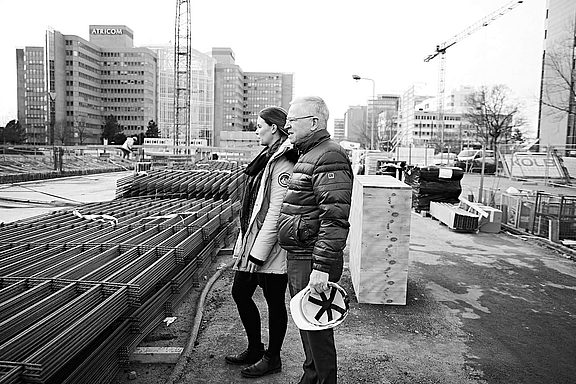
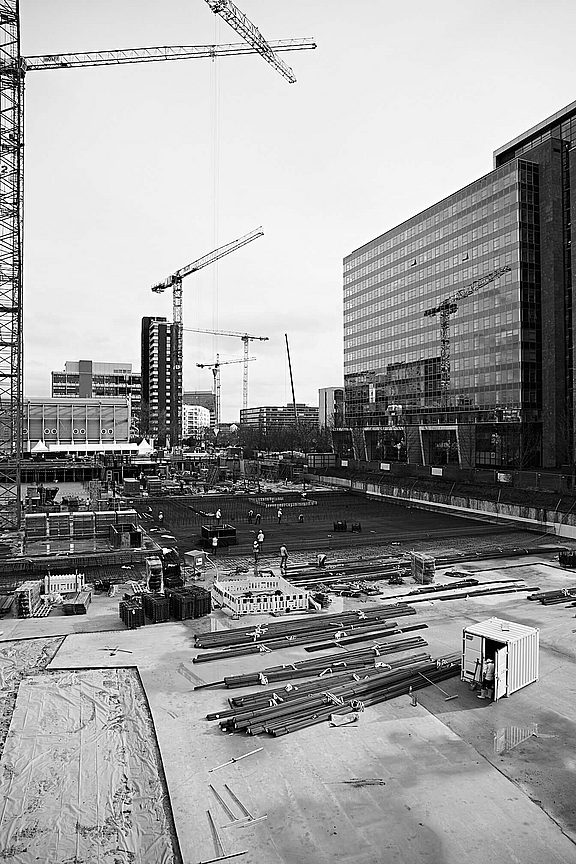
Planning begins in March 2019, construction starts in October, the foundation stone is laid in January 2020, and completion is scheduled for the end of 2021. That is the schedule for the new DekaBank building in Niederrad. Close cooperation between all parties involved is essential for such a complex planning and approval process.
A conversation between the client, future user, and architect about trust and responsibility in collaboration.
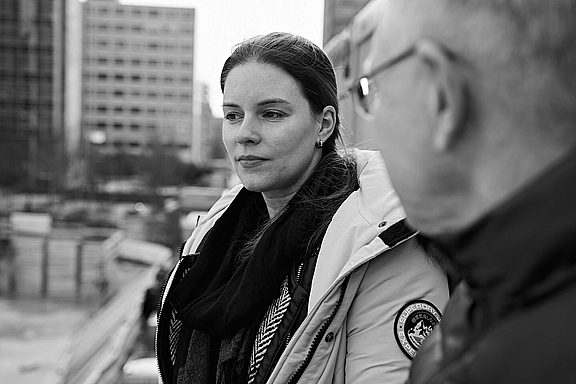
Sandra Pfitzmaier, Head of Corporate Real Estate Management and Project Manager, Deka Immobilien Investment GmbH
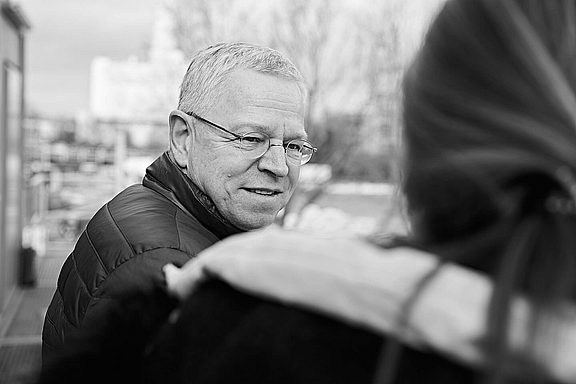
Thomas Glatter, CEO Lang & Cie. Real Estate AG
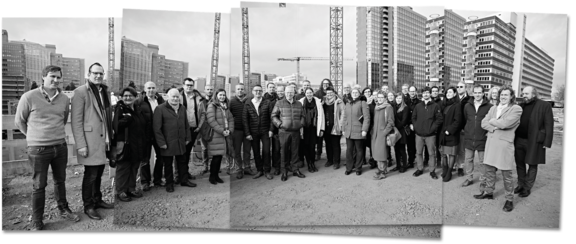
Holger Meyer & Gregor Gutscher, Managing Directors, holger meyer architektur
Ms. Pfitzmaier, how do you see your role as representative of the future tenant in this constellation?
Sandra Pfitzmaier (SP): As project manager at Deka Immobilien Investment GmbH, Deka's real estate subsidiary, my team and I are responsible for the internal planning and coordination of the project. We also act as the interface with the developer Lang & Cie. We collect, evaluate, and filter the requests and suggestions that are submitted to us internally. In this respect, I am the contact person within Deka on the one hand and, on the other hand, the messenger of wishes to Mr. Glatter for hopefully feasible requests.
And you, Mr. Glatter?
Thomas Glatter (TG): First, I would like to add something that Ms. Pfitzmaier omitted. Together with two of her colleagues, she is also the decision-maker. That is the most important thing. Because conveying wishes is one thing—but the way in which certain tasks are implemented in terms of construction has to be coordinated and decided upon. Without a decision, we are stuck in the same place.
My role within the project team is what I would describe as "jack of all trades." I work in areas that are sometimes overlooked by planners and users, such as the process organization of bank reporting. As the client, I manage the planning team and am responsible for the tendering process and all contract awards. I am in close contact with the construction site and select the right companies. Ultimately, I need to know what is happening where in detail.
Above all, however, is the collaboration with Deka. The closer the contact here, the greater the likelihood that we will get it done cleanly within this ambitious timeframe.
And how does the architect, Mr. Meyer, assess this?
Holger Meyer (HM): Projects that we plan directly for and with a user are always the most enjoyable. In this process, we act as mediators between the user and the client. On the one hand, we have to reflect, adopt, and implement the user's wishes—on the other hand, we have to keep the economic interests of our client in mind. Traditionally, we strive for good architecture in every project. To a certain extent, this is expected of us because we all want to create sustainable quality together. Not only in terms of content for the people who will work there, but also in terms of the architecture as a whole.
This process must be balanced and moderated together again and again. Everyone must listen to each other. Only with such a basis of trust can it work well in the short term. Take time, listen, then make a decision together and consistently follow the path together. We just sat down again to discuss the restaurant and quickly agreed: we can do even more. It's worth taking another look. These are exactly the issues that require time. Despite all the hustle and bustle of the process, we need to pause and not lose sight of our common goal.
TRUST
SP: Trust is a good keyword. This was also a recurring topic during the lease negotiations: How can we ensure that there will be no delays in the process and that we will be able to take over the building on time on November 15, 2021? There are a lot of mechanisms in the lease agreement that protect us from delays on a legal level. Nevertheless, we already said during the negotiations: "We can do this. We have to be cooperative. Of course, there will be friction at times. But ultimately, we all have the same goal in mind." Trust, commitment, and courage—those are the three qualities that are needed.
HM: And respect – for the tasks of our planning partners and the processes they are involved in. Internally, I can make decisions very quickly because Gregor Gutscher and I don't have to follow any decision-making procedures. But it's different in a large organizational structure with multiple decision-making levels. It's precisely these decision-making chains, which work like gears in a transmission, that you have to know and respect. It's not just Ms. Pfitzmaier, Mr. Glatter, and Mr. Meyer. Behind them are the respective teams. It's extremely important to place issues in the right place. There are short paths for everything. We know them. And everyone knows how to communicate quickly with each other.
Gregor Gutscher (GG): Understand what you are doing yourself and develop an understanding of how others act. Then filter out the important decisions that need to be made in order to move forward. You always have to keep the "what-happens-next machine" in mind when making decisions. It's a bit like chess. I actually have to think five moves ahead.
TG: As project developers, we had been aware of the site in Niederrad for a long time and had explored various options for it. In 2018, we made initial contact with Mr. Bäcker from Deka, and things started to move forward. I called Mr. Meyer for the first time in December 2018. His first question was: "When will it start?" My answer: "January or February at the earliest." Three days later, I made my next call. The initial concept was ready before Christmas.
I know Mr. Meyer from working together on various projects. He has worked in banking and knew Mr. Bäcker from a previous project. When you tackle a project that is under extreme time pressure, you have to make sure that the teams work together perfectly. You can't afford a two- to three-month discovery phase. The most important thing is to have the driving force at the front: the architect—they have to be right. We sat down with Ms. Pfitzmaier for the first time in January 2019. We had just tried to implement the first room program. She said, "That wasn't bad—but please do it again anyway." The first test. But the chemistry was right and it continues to work great.
HM: The confidence-building measures actually start before that. A project works best when everyone is completely open with each other. When you try to find the best solution in discussion with all stakeholders. That is the basis for designing an efficient and optimized process. The key parameters for this are defined in advance. The development of the concept is, after all, an early part of the planning process. And that has to work very directly and on demand. When Mr. Glatter calls early in the morning and says, "The house is getting bigger. I've already done the calculations. I'll send you a sketch later," it's already on the table when you arrive at the office. (laughs) But Mr. Glatter also knows that we take his sketch seriously and that he will receive a response quickly. This allows him and Ms. Pfitzmaier to get back to work. It simply has to work smoothly.
At this early stage, the decision-making processes are even more diverse. You have to convince many other people and groups. If one person doesn't know what the other is doing or is only half-hearted about it, you won't be successful in the end.
COURAGE
HM: There are projects that suffer because no one wants to take responsibility. Sometimes unpleasant decisions have to be made, which can quickly cost €200,000 in projects of this magnitude. If you are unable or unwilling to make these decisions, the engine stutters. Then the wheels no longer mesh because I am sent home and asked to examine six more options. Unfortunately, this is often how large-scale projects unfold. And ultimately, it is usually because no one wants to make decisions. We do the opposite: when we identify a problem, we pick up the phone.
SP: That's what I mean by courage. A less than optimal decision is still better than no decision at all. At Deka, trust is practiced from the top down. Everyone enjoys an incredible amount of freedom to make decisions: our internal team has a wealth of expertise at its disposal; without the relevant team members preparing the issues, it would not be possible to make quick decisions. That gives me a tremendous amount of confidence and security.
I think that's rather unusual in structures like this. We are all people who are fundamentally willing to make decisions. We want to do that. We like working that way. Nevertheless, you can never be reckless and you have to be careful not to decide too quickly. We understand each other almost blindly in this regard, too. Either you let yourself be convinced or you convince the others that there is a better solution. But that requires the concentrated cooperation of everyone.
HM: We are working determinedly toward a good architectural result, and everyone involved is highly committed. There have been times when we have all taken a step back in order to move the project three steps forward. You have to work against your own comfort zone and constantly question yourself critically. And have the courage to take another loop. That's good for the project.
GG: A good example for me is the staircase in the lobby. We architects always thought it was a super important element. So we placed the staircase in the middle of the room as a grand gesture. But no one was really happy with it. And then it started: first it was angular, then it was round. It looked completely different—but people still didn't like it. After four rounds, we came to the conclusion: we're taking the staircase out of the room. As an architect in the planning process, you would now say: Stop! A different planning basis – that's a change and now costs more. In this project, with a client who makes quick decisions in our favor, he also has the right to say, "Let's do it differently now."
SP: We also learn a great deal during the course of such a project. We are not omniscient and cannot formulate exactly what we want right from the start. Internally, we are also in a development process—we have to learn and constantly remind ourselves that we want to create a new "home" for our employees here. This should and must permeate the entire building. I usually spend more time with my colleagues during the week than with my family. Consequently, I need to feel accepted and welcomed there. We want to create the best possible environment for employees and visitors – not just a representative office.
So, when it came to the staircase in the lobby, the question arose: Is this the impression we want to make when people enter the building? We didn't want a humble "Oh! Wow!" but rather a "Hey, wow... I feel comfortable here. I can and want to work here all day." This required less pathos.
HM: The entrance area has been moved to the second row and no longer obstructs the view. The lobby is now a very orderly, clear space, a marketplace around which functions are arranged. And the staircase is one of these functions. That is the learning process described: two steps forward, one step back. The staircase was one of the important decisions; you have to distinguish that. But you can't allow that at every point, otherwise you won't get any momentum into the process and you'll get bogged down in details.
COMMITMENT
Everyone in the team is an experienced professional and brings a wealth of experience to the project. Is that an advantage for the planning process? Does it make it easier to find common ground?
TG: I think it helps enormously that we have highly experienced contacts at Deka. We often work with clients who are not used to reading plans. At Deka, on the other hand, we have Mr. Bäcker, Ms. Pfitzmaier, Mr. Hasenbein—the entire team—who are very technically savvy and have a wealth of experience. This team is highly professional. There is little vanity or desire to stand out. It doesn't matter whether an idea comes from Mr. Meyer, Mr. Gutscher, or someone else on the team. They simply listen, take note of the suggestions and reservations, and then implement them professionally as a group.
HM: It's a question of attitude and the level at which you communicate with each other. Planning is such a sensitive business. The trust you've built up over the long term can be destroyed very quickly. Everyone needs to be aware of this balance, then it works, then you can really get things moving.
SP: It's not difficult for us to view the project from an architect's perspective because, as experienced specialists in real estate investment, we are also experts in the field.
We had to learn to put ourselves in the user's shoes. Of course, we understand the interests of a project developer, the difficulties that can arise during the construction process, and what it actually means to complete projects on schedule. That makes it easy for me to put myself in the other person's position. Not least because I am an architect myself.
The short implementation time is certainly a challenge. How important is it for the team to communicate on an equal footing? For everyone to understand each other's business? Did that convince you that "we can do this"? And when was that: after you met the developers and architect? Or was the deadline already set beforehand?
SP: The deadline is based on the move-out date from our current building, which is the end of 2021. Of course, we could have done this with other partners. But there was a reason why we recommended this particular constellation to our board as the best one for us: because there was confidence in everyone's ability to deliver. If we had been afraid that the deadline could not be met, we would not have been allowed to sign this contract.
On the surface, it might be easier for us as users and for the planning process if we didn't show up for the next two years. The two of you could plan and build in a two-person constellation, which is nice and right in order to complete it safely within the tight time frame. It might not be what we would have wanted—but it would be finished.
TG: That would probably result in a building that you would have to renovate and tailor to your needs from day one. That wouldn't serve anyone's interests. The aim is to minimize risk on all sides. My schedule at the beginning of 2019 was a single sheet of A4 paper. Looking at it today, we are on schedule except for two or three days. That's... not bad.
We are well on track, despite or perhaps because of this seemingly laborious process. If we didn't listen and allow open discourse in some areas, we wouldn't get the result we all want: a good, sustainable building where Deka employees feel comfortable.
RESPONSIBILITY
SP: Despite our different interests, I find what we are achieving here together very impressive, and I am also personally very proud of it. I think it's great how little friction there is in the project team—in my opinion, it's exemplary. I will take this with me not only into future projects, but also to the office every day. The team spirit is incredibly motivating. Everyone is pulling in the same direction, everyone is working hard, everyone has very high standards, is diligent, and puts their own personal feelings very much in the background.
HM: When vanity or profile neurosis come into play, it becomes problematic—we all know this from other projects. There are many who believe they are incredibly important. That's the point where something can quickly happen that can no longer be reversed. In contrast, we experience that there is another way. This creates the motivation to say, "I want to work like that too." If everyone takes that away from such a project, then that's real added value. Even if you have to be aware that it can't always work that way. It always depends on the people and the chemistry.
TG: To answer the question briefly: trust and responsibility. First of all, I have fundamental trust in everyone who is working on the project. But I also expect everyone in whom I invest this trust to be aware of the resulting responsibility. Otherwise, it won't work. And by that I explicitly mean trust in the companies carrying out the work. We know this from the 1990s, when general contractors in particular were viewed as adversaries. This quickly led to a spiral that could no longer be broken: the client protects itself with contracts that put the contractor in a tight spot. The contractor then retaliated with various claims. The client did the same, with legal advice throughout the construction process. This can only be broken with trust, otherwise you have to stop building. Here, it is important to know very early on exactly who you want to and can work with. In planning and in execution.
That's why, instead of a large construction company or a general contractor, we always look for medium-sized companies where there is still a boss with integrity who owns the business.
I want to be able to call someone who will then make a reliable decision. I want to be able to negotiate with someone when there is stress on the construction site—with delays, costs, addenda, or any other issues—and be able to say, "Okay, this is what we're going to do now. Handshake deal."
On the other hand, I want to see such qualities handled responsibly at all levels of the project. We mustn't forget the approval processes in such a project. It was actually a joint effort to a large extent. Everyone involved used their good contacts with the city and the committees to obtain approval as quickly as possible.
TG: First and foremost, the building inspectorate, of course, but also all the specialist departments. It's about personally attending meetings to present ideas, ask questions, and make decisions. It's tedious, but it simplifies and speeds up the entire review process. To put it bluntly, as Lang & Cie., we can't afford to build something bad in Frankfurt. It may not catch up with us today or tomorrow, but it will definitely catch up with us the day after tomorrow.
HM: I think we are all familiar with other scenarios. Everyone knows what it means when you suddenly have a myriad of consultants or lawyers sitting at the table. That leads to deadlock. Experience teaches us that it is better for everyone involved to remain at a level where you can still talk to each other when there is a problem.
SP: You have to keep reminding yourself of that. We try to maintain a high level of motivation and morale within the team, which results in good cooperation. That's the much bigger task. Especially given the short time frame and the amount of work we have, it's often stressful. Not necessarily in a negative way – but there are a lot of balls you have to keep in the air at the same time. In times of doubt, things can happen out of emotion. Then you have to remember: maybe things went wrong at that particular moment. But that shouldn't spoil the mood in the project team in the long run and make us forget that the other 99 percent is going very, very well.