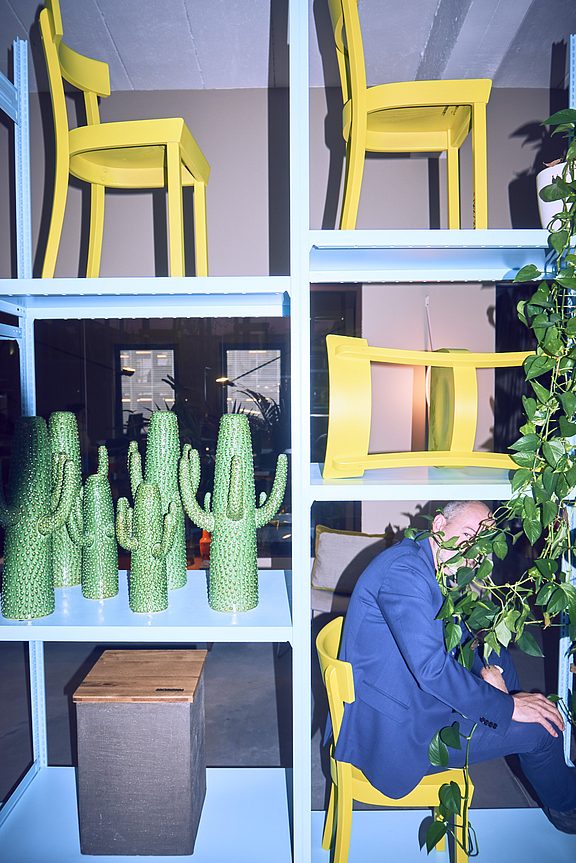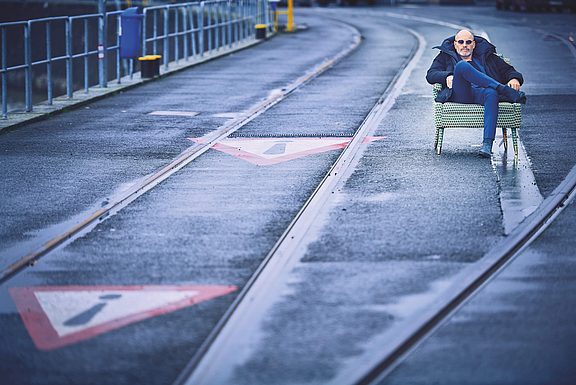
Have you always wanted to be an interior designer?
Thomas Tritsch (TT) | No, it happened indirectly and wasn't my goal. I'm actually a sculptor and trained carpenter. Twenty-three years ago, I became a father—and suddenly had to earn money. My partner, Sabine Mühlbauer, is an architect, and we decided to join forces professionally. We wanted to find a symbiosis between art, space, and architecture. At the time, we were already living around the corner on Hanauer Landstraße. With a gallery on the ground floor, a workshop in the middle, and the living quarters above. And that's where we started with art exhibitions, which eventually turned into parties. We still enjoy doing that today.
Good point... Your parties have become something of a cult phenomenon in Frankfurt.
TT |I like the idea of a salon. How can you bring people together? How does communication develop? How do joint projects come about? We are curious and open-minded. And the events provide a platform for meeting new people. Then as now.
Holger Meyer (HM) | We, on the other hand, got to know each other through a project. It was for a small, compact office extension for Hans-Jürgen Heiderich, a good customer and also a friend, who is very interested in art and design. We have no reservations about getting involved, which is rather unusual in our industry. I really appreciated the fact that you were so relaxed in your dealings with both sides. Your motto was: "I want to understand the architecture, I want to understand the guy." This resulted in a very natural workflow. We developed a beautiful product together. We suggested many things and discussed many things. But there was never any conflict, only a constructive path to the goal. The project was not without its challenges, but it led to a great result.
TT | Well, all three of us had the basic attitude that you should treat others with appreciation and acceptance. Not many of your colleagues do that. With you, I feel like I can learn from you. And I also believe that you were able to take something away from us. That's actually the beauty of it. I hate doing projects on my own. It's really nice when the client also has a say and contributes their ideas. I believe that a project can only be successful if the client or partner also makes it their own project. And doesn't feel like something is being forced on them.
Gregor Gutscher (GG) | I got to know you during the interior design of our office and at a joint competition. In both cases, it was important to me that sometimes you have weird ideas. Then it's important to have people around you who listen to them and say, "That's really weird—but also really great." That gives you a certain amount of confidence in what you're doing and prevents you from getting stuck in your own rut.
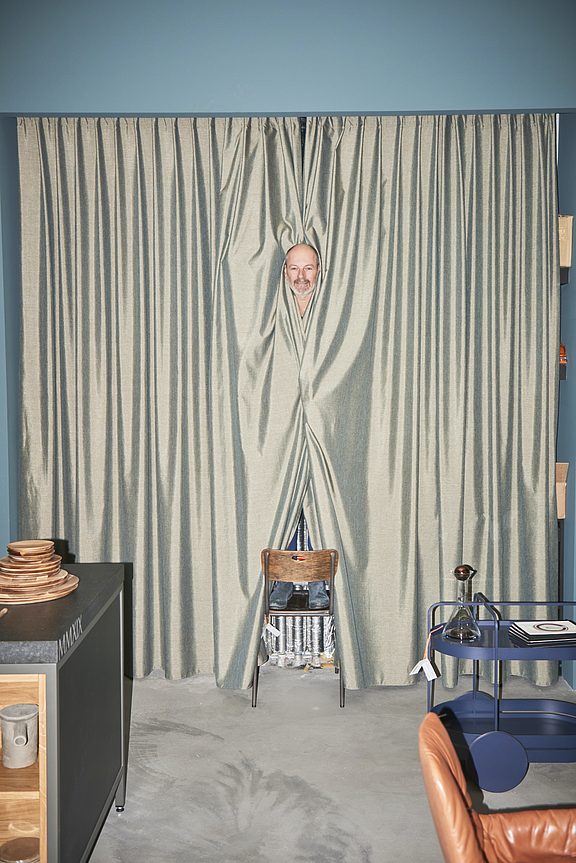
TT: Yes, dialogue is extremely important. Let me give you an example: I find it incredibly difficult to furnish my own home. My apartment looks completely different from the office here. That's because I would have to engage in a dialogue with myself. That's much more complex than when I'm furnishing your apartment. When you engage in a real dialogue, it's always more exciting, more enjoyable, and also more intense.
HM: I think the detour is part of the process. That's also the case with competitions. We always have the incentive to improve, and to do that, we have to constantly question ourselves. That's where comparison with others, but also exchange in the office, comes into play. Dialogue means friction—it doesn't run smoothly from the start.
TT: It's like mediation.
HM: If everyone lets the others do their thing, then it can work that way.
TT: In interior design, we really have to get into psychology. That's why I no longer work for couples. When a couple comes in, I say right away: I only work with one of them. It will never work with both of them. Because otherwise it goes like this: The man wants a kitchen, an expensive one. And then she says: You never cook. And he says: Then I'll start cooking. And so it goes on. It just doesn't work.
HM: I'd like to tell you the story of when we planned a single-family home for a good customer, which was a rare occurrence. The first evening meeting with red wine lasted late into the night. At eight o'clock the next morning, my phone rang: "My wife is about to call... please tell her this, that, and the other..." After just one evening, we had already reached the point we never wanted to reach. That's the problem—it gets too personal.
TT: Exactly! And you're right in the middle of it. Most divorces happen during construction.
HM (laughing): I don't know the statistics.
TT: You run out of goals. Ultimately, it's like this: you have a relationship, you get married, then you have children. And then you start building because it distracts you from all the problems that come with having a family. Building creates a whole new set of problems. And woe betide you when the building is finally finished. Suddenly, you no longer have any common goals.
GG: And you've probably built a compromise, because both of you were involved in the process.
TT: Exactly. You've built a compromise and no longer have any common goals. The children leave home. There are no more shared obligations. Then you have to ask yourself: Do you still have anything in common?
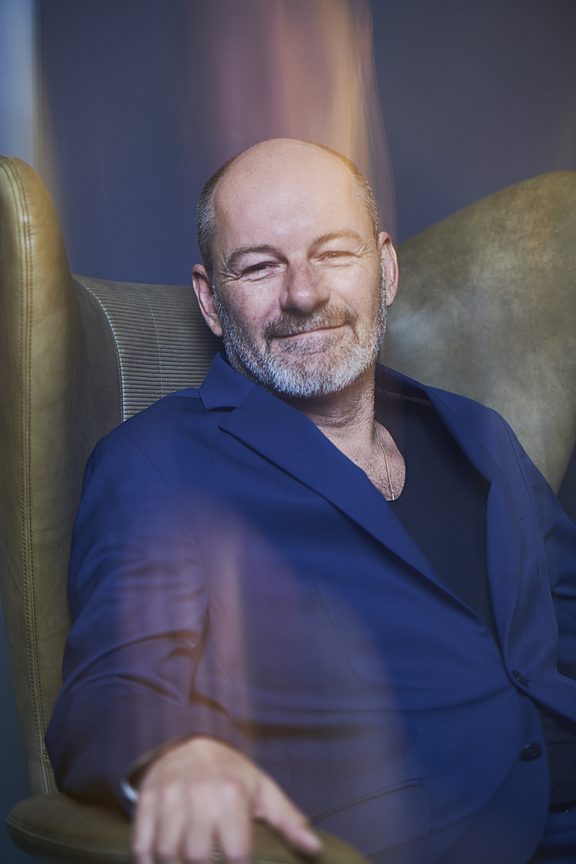

Which brings us back to the topic of mediation. The comparison is apt because it describes the process that the architect embarks on with you. Of course, only if he is open to it and you can inspire each other. What are your inspirations?
TT: I am inspired by the great architects of classical modernism. Here, everything is also quite classic, wood and stone. We always try to be authentic and honest. For example, we don't work with plastic. Instead, we use rubber—materials that feel good, have a good history, and, ideally, are also sustainable.
I don't go to trade fairs at all. We have a good position with the store. People come to us who want to show us something. That's more pleasant than wandering around a trade fair.
In addition, this space here is something special. It's also called Morgen and Friends. We have personal contact with everyone who has something here. That has grown over time and is becoming more and more so.
HM: I think that's your unique selling point. You steer clear of the mainstream and don't follow the beaten track. You feel more comfortable in a niche and with people who don't represent the mainstream. That keeps things exciting and leads to results with a character all of their own.
TT: It also prevents you from getting bogged down. I turn down a lot of things and prefer to do less with people I get along with. Where the appreciation is right.
GG: Yes, it has a lot to do with people and quickly becomes very emotional.
TT: It's about attitude, attitude towards everything. I think in terms of attitudes: Does this suit us? Does this suit the customer? Is it genuine? That's also the beauty of our events. People aged 18 to 70 come, many with their children. We offer a platform where people meet and connect. That's what makes me happiest.
Where does the name "Morgen" actually come from?
TT: That's relatively simple. We wanted something that had to do with the future. So we called ourselves Morgen. I still love the name. We have registered it as a word mark.
HM: It also exists in English, For Future. It was the word of the year in 2019. Morgen is the purely German version, so to speak.
Twenty years ago, this was the wild east of Frankfurt. You've been there for the whole development of Hanauer Landstraße.
TT: I hope that the east remains a little rough, as it is now. I love this view over the Osthafen.
HM: You also have to ask yourself, where can Frankfurt still develop? How should things develop, and where? That's definitely an issue.
TT: Take a look at Hamburg. There are still some really gritty corners there. I think that's nice.
HM: They've done a good job of retaining their character despite all the changes. But what happens to parts of a city that are entering the next cycle? Like in New York?
TT: Yes, gentrification—that's a shame. In New York, everything will look different again in two years. I'm sure of that.
You're evolving too. Do you still prefer doing small jobs, or are large projects now your priority?
TT: I prefer working on hotels. It's like a machine that has to function. It's really exciting work. You spend two years on it and experience a process. It's better than a private apartment. Besides, that's what keeps the business going. Probably the same as with your large-scale projects?
GG: Of course, you can only run a big business if you have a foundation of larger orders.
Do you still have a dream project?
TT: My dream is to build my own hotel, a Morgen Hotel. In Mallorca. And a Morgen Forest for the Morgen Hotel. That fits in with our idea of becoming CO2-neutral. We're thinking of an online shop where you buy a tree with every product, which we will then plant. In the Morgen Forest, of course.
Thank you very much for these insights.